An international research team, led by UNSW researchers, has identified why mangroves thrive on some coastlines yet die on others.
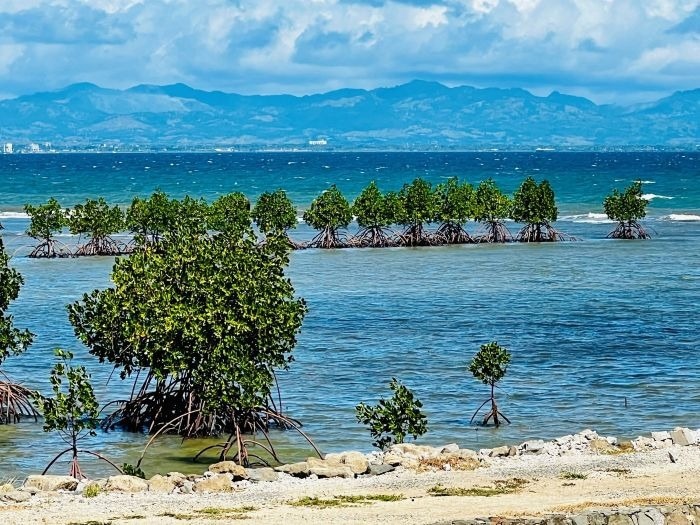 Mangroves being grown in Fiji as part of the UNSW-led Project Halo. Image Credit: UNSW
UNSW researchers have identified why mangroves thrive on some coastlines globally yet die on others.
The discovery of so-called ‘windows of opportunity’ when young plants are being established will help identify where and when mangroves are most likely to take root – improving efforts to conserve these important coastal forests that provide environmental, social, and cultural benefits.
The findings could have important implications for mangrove restoration and conservation projects globally, where significant amounts of money are being spent to re-establish and protect these valuable ecosystems.
Mangroves play an important role in shoreline protection by mitigating the power of waves and storm surges, as well as providing a natural store of carbon from the atmosphere, and offering a home for many fish and bird species.
“Worldwide, millions of dollars are being spent on mangrove restoration projects that are often failing. If local studies are conducted, they typically focus on average conditions and not on the key thresholds that limit growth,” says Professor Will Glamore from UNSW’s Water Research Laboratory, School of Civil and Environmental Engineering.
“This work is critical as it emphasises how short periods of ideal conditions, not long-term average conditions, can play a critical role in ensuring mangrove can establish and develop.
“You can think of it in terms of a baby compared to an adult. A baby is so much more vulnerable than an adult, and we need to consider that vulnerability when we undertake mangrove restoration or conservation.”
Low Wave Energy is Critical
The international research findings, published in the prestigious journal Nature, are based on an analysis of 20 years of wave data from 400 sites around the world; 200 where mangroves were present and 200 where they were absent.
The international research team, including researchers from UNSW Sydney (Ms Sarah Wells, Dr Brad Henderson, Associate Professor Andrew Dansie and Prof. Glamore), the USA (Professor Dan Friess, Tulane University) and Germany (Professor Thorsten Balke, University of Oldenberg) found that sites with mangroves generally experienced longer periods of low wave energy allowing young plants to establish and thrive.
“Mature mangrove trees are very resilient against waves and can tolerate quite a lot of wave force, which is why they’re often considered for coastal protection,” says Sarah Wells, a UNSW PhD candidate and corresponding author of the paper.
“But in the first three months or so, during the seedling stage of life, they are highly vulnerable to waves.”
Using global data, the researchers developed an approach that correctly predicted mangrove presence or absence at over 75% of the sites studied.
The work shows that although mature mangroves may survive substantial wave forces, new seedlings need ‘windows of opportunity’ with relatively low wave energy to anchor their roots and withstand stronger conditions.
And if those conditions are not available, the seedling can simply be washed away or undermined by erosion.
Windows of Opportunity
The international research team combined the ‘windows of opportunity’ concept, developed by co-author Professor Thorsten Balke of the University of Oldenberg, with a wave exposure framework based on global data analysis.
This showed that young mangroves become progressively more tolerant of wave energy as they age, with the steepest increase occurring during the first three months.
“In this study, we examined a range of different ‘windows of opportunity’ worldwide,” Ms Wells says.
“For instance, a one-day-old seedling can barely tolerate any waves, while a one-week-old seedling can tolerate some waves. This tolerance increases as the mangroves age. Understanding those windows of opportunity is particularly important for restoration.”
The published study is part of Project Halo, a collaborative research project between Australia and Fiji that is restoring degraded and urbanized coasts with innovative nature-based mangrove solutions.
The philanthropically funded project includes social, economic, ecological and engineering research to support on-ground actions.
Mangrove restoration is often undertaken because of the benefits the coastal forests can provide, including wave protection.
But that creates something of a paradox: the places where mangroves could provide the greatest protection from waves may also be some of the most difficult places for young mangroves to establish.
The new research could help restoration planners identify suitable locations before investing significant amounts of money and effort. It could also help identify when planting is most likely to succeed.
“If we understand the local forces impacting growth, we should be able to optimize restoration and conservation,” Ms Wells says.
For example, if wave conditions are typically calmer during summer, restoration could be timed to take advantage of that seasonal window. In some circumstances, structures could also be used to reduce wave energy to allow seedlings to establish.
Climate Change Impacts
The findings may also offer a new way of thinking about how climate change could affect mangrove forests.
“Mangrove forests provide so many ecosystem services that are important for coastal protection, food security, biodiversity, and local livelihoods,” says co-author A/Prof. Dansie. “This new research is critical in considering global mangrove forests and their benefits in the face of rising sea levels and changing wave conditions”.
Climate change is not expected to produce bigger waves everywhere. In many tropical and subtropical regions, changes in the wave direction could be particularly important.
The study's measure of wave exposure takes both wave height and direction into account. In other words, a wave of a given size can have a different effect depending on the angle at the shoreline.
The researchers found that relatively small changes in wave conditions could alter whether a site experienced a suitable establishment window.
“We found that the direction of the waves coming into the coastline, the angle of incidence, is very important, but often not considered,” Ms Wells says.
She says projected changes in wave climate across the tropics are expected to include shifts in direction, meaning that even without a dramatic increase or decrease in wave height, conditions for mangrove establishment could change.
The study's results suggest that some existing mangrove sites may become unsuitable for new seedlings, while other unsuitable sites may become more favorable.
While these changes influenced site suitability, the researchers stressed that waves are only one factor affecting future mangrove distribution, alongside conditions such as sea-level rise, tides, salinity, temperature, and sedimentation.