Sponsored by ServomexReviewed by Olivia FrostNov 9 2026
Servomex provides a range of gas analyzers specifically designed to meet the quality assurance, process control, and safety monitoring requirements of air separation units (ASU).
Image Credit: dee karen/Shutterstock.com
Dry air contains approximately 78% nitrogen, 21% oxygen, and 1% argon alongside low concentrations of carbon dioxide, noble gases, hydrocarbons, and other impurities.
Large quantities of nitrogen, oxygen, and argon are used by industry, prompting them to be referred to as ‘industrial gases’. Appropriate processes have been developed to produce these gases via the separation of air.
An air separation plant divides atmospheric air into these three pure gaseous components: nitrogen, oxygen, and argon, with some plants performing further separation in order to produce other gases such as krypton, neon, and xenon.
Atmospheric air’s other gas components must be removed to ensure safe, efficient plant operation and product quality, including carbon dioxide, hydrocarbons, and water vapor.
Different types of air separation plants exist, but plants leveraging cryogenic air separation are the most significant in terms of volume and production value, with this method presenting the most opportunity for gas analysis.
Cryogenic Air Separation Applications
Large air separation plants are based on the cryogenic fractionation process, dividing air into its pure components. The underlying principle of this process is that desired products have different boiling points, meaning they can be separated out from liquefied air.
Varying user requirements mean there are a number of variations in the air separation cycles employed in the manufacture of industrial gas products. All cryogenic air separation processes are comprised of a similar series of steps, however (Figure 1).
Air Compression and Filtering
The ambient air feed is compressed to a pressure of approximately 6 bara using a multi-stage compressor with intercoolers. A filter located at the inlet to the compressor is used to remove dust.
Air Cooling and Purification
Compressed air is cooled to close-to-ambient temperature by passing it through a direct contact water cooler. An evaporation cooler is used to chill the cooling water using dry nitrogen waste gas from the process.
A large portion of water vapor from the incoming air is condensed and removed via passage through the compressor and cooler. Most of the remaining water vapor, hydrocarbons, and carbon dioxide are removed using molecular sieve absorbers.
Refrigeration and Liquefaction
Next, the purified compressed air feed is cooled using a ‘cold box’ containing heat exchangers and refrigeration processes, where it reaches a cryogenic temperature of approximately -180 °C.
Final cooling is achieved by expanding the feed using an expansion engine before the mixture of liquid and vapor air is separated and fed into the separation column.
Separation
The separation column is comprised of a high-pressure and low-pressure column, which is used to separate air into its pure components.
The mixture of liquid and vapor air from the refrigeration and liquefaction stage is fed into the high-pressure column, where it separates into nitrogen at the top of the column and oxygen-enriched air at the bottom.
This oxygen-enriched air is then fed into the low-pressure column, where it is purified further. Pure nitrogen is finally taken off the top of the high- and low-pressure columns, and pure oxygen is withdrawn from the bottom of the low-pressure column.
Argon is enriched in the middle section of the low-pressure column, known as the ‘argon belly’. Additional concentrating steps can be used to withdraw this argon and process it to pure argon.
Pure Argon Production
Argon was historically produced by feeding the stream from the low-pressure column’s argon belly to the crude argon column, then passing the product through a catalytic converter to remove the remaining oxygen before removing any nitrogen in the pure argon column.
The modern process involves passing the stream from the low pressure column into the crude argon column to enable further separation. Any remaining oxygen in this gas stream is entirely removed in this packed column, with the oxygen-free argon stream then fed into the pure argon column in order to remove the remaining nitrogen via separation and liquefy the pure argon.
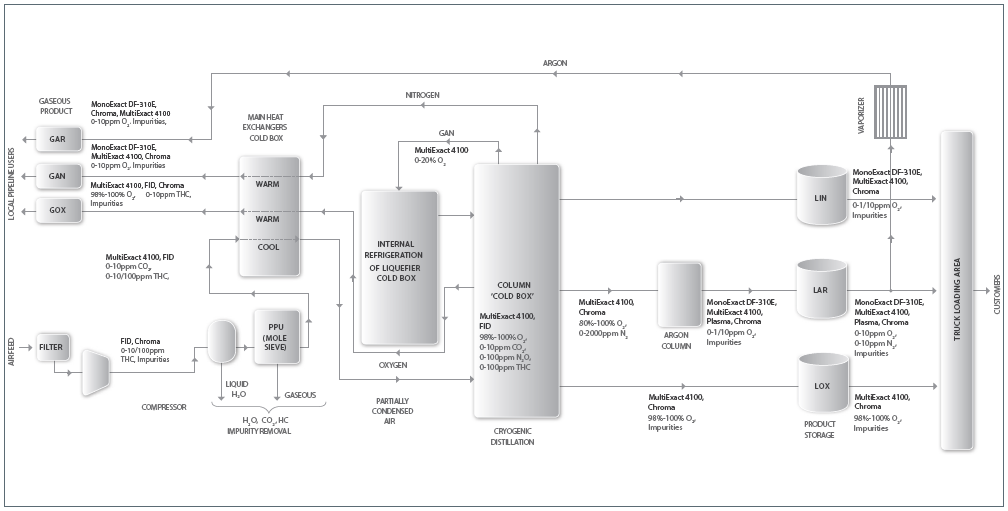
Figure 1. Typical Air Separation Plant. Image Credit: Servomex
Process Measuring Points
Figure 1 details the position of typical measuring points in a typical cryogenic air separation plant. Table 1 lists the respective gas analysis requirements alongside the ranges and Servomex analyzers best suited for each of these measurements.
Typical gas analysis (refer to ASU flow schematic Figure 1). Source: Servomex
| Installation location |
Gas measured |
Measuring range |
Application |
Servomex analyzer |
| Process air before molecular sieve |
THC
Impurities |
0-10/100 ppm
0-10/100 ppm |
Safety |
SERVOPRO FID
SERVOPRO Chroma |
| Feed to high pressure column |
CO2
THC |
0-10 ppm
0-10/100 ppm |
Safety |
SERVOPRO MultiExact 4100
SERVOPRO FID |
| Low pressure column liquid phase |
O2
CO2
N2O
THC |
98-100%
0-10 ppm
0-20 ppm
0-100/1000 ppm |
Control
Safety |
SERVOPRO MultiExact 4100
SERVOPRO MultiExact 4100
SERVOPRO MultiExact 4100
SERVOPRO FID |
| Distillation column process stream |
O2 |
0-20% |
Control |
SERVOPRO MultiExact 4100 |
| Feed to low pressure column |
O2 |
0-50% |
Control |
SERVOPRO MultiExact 4100 |
| Crude argon column feed |
O2
N2 |
80-100%
0-2000 ppm |
Control |
SERVOPRO MultiExact 4100
SERVOPRO Chroma |
| Feed to pure argon column |
O2
N2
N2/O2 |
0-1/10 ppm
0-5000 ppm
0-10% |
Control |
SERVOPRO MultiExact 4100/MonoExact DF310E
SERVOPRO Plasma
SERVOPRO MultiExact 4100 |
| Liquid nitrogen before and after. storage |
O2
Impurities |
0-1/10 ppm
0-10 ppm |
Control/Quality |
SERVOPRO MultiExact 4100/MonoExact DF310E
SERVOPRO Chroma |
| Liquid oxygen before and after storage |
O2
Impurities |
98-100%
0-10 ppm |
Control/Quality |
SERVOPRO MultiExact 4100
SERVOPRO Chroma |
| Liquid argon before and after storage |
O2
N2
Impurities |
0-1/10 ppm
0-10 ppm
0-10 ppm |
Control/Quality |
SERVOPRO MultiExact 4100/MonoExact DF310E
SERVOPRO Plasma
SERVOPRO Chroma |
| Gaseous oxygen |
O2
CO2
THC
Impurities |
98-100%
0-10 ppm
0-10 ppm
0-10 ppm |
Quality |
SERVOPRO MultiExact 4100
SERVOPRO MultiExact 4100
SERVOPRO FID
SERVOPRO Chroma |
| Gaseous nitrogen |
O2
Impurities |
0-1/10 ppm
0-10 ppm |
Quality |
SERVOPRO MultiExact 4100/MonoExact DF310E
SERVOPRO Chroma |
| Gaseous argon |
O2
Impurities |
0-1/10 ppm
0-10 ppm |
Quality |
SERVOPRO MultiExact 4100/MonoExact DF310E
SERVOPRO Chroma |
*Only applies to modern processes using packed crude argon columns
Analysis Requirements
Air separation units face a significant challenge in minimizing production costs while maintaining product safety and quality. Gas analyzers are used throughout the process to meet this challenge through continuous, reliable analysis.
Oxygen Analysis (% Levels)
Oxygen analysis is key to process control and verifying oxygen product quality. The SERVOPRO MultiExact 4100 from Servomex is highly suited to this analysis due to its use of an inherently linear paramagnetic oxygen cell along with pressure compensation. This allows the MultiExact 4100 to measure up to 100% oxygen with an accuracy of 0.02%, without the need for special reference gases.
Oxygen Analysis (ppm Levels)
Oxygen analysis is also required in the range of 0 to 10 ppm. The zirconia-based technology utilized by the SERVOPRO MultiExact 4100 is ideal for this measurement application, with the instrument’s unique zirconia sensor leveraging an inhibited catalytic design that is not adversely impacted by trace combustible gas potentially present in the sample.
These advantages combine with the instrument’s rapid response speed, making it an ideal option for monitoring the quality of the nitrogen and argon product streams where oxygen is considered an unwanted impurity.
Oxygen Analysis (ppb Levels)
Oxygen analysis at sub-ppm levels is often required to verify the quality of argon and nitrogen product streams before these are supplied to the customer. Servomex’s SERVOPRO MonoExact DF310E analyzer can readily analyze ppb levels in oxygen using its unique non-depleting coulometric sensor technology, making it ideal for quality analysis of the final product.
Carbon Dioxide Analysis
Carbon dioxide must be removed from the ambient air feed for safety and quality reasons, with analysis required to verify this. Carbon dioxide analysis is also key to ensuring that end products meet the required specifications.
Servomex’s SERVOPRO MultiExact 4100 is especially suited to this analysis because it leverages gas filter correlation (GFC) technology to ensure a specific, sensitive, and stable measurement.
Nitrous Oxide Analysis
There is a risk of nitrous oxide accumulating in the low-pressure column, potentially causing safety issues and contaminating the end product. Analysis is required from this region to check this, with the SERVOPRO MultiExact 4100’s reliable GFC technology making it ideal for this purpose.
Total Hydrocarbon (THC) Analysis
Total hydrocarbons must be monitored in the air inlet feedstock in order to ensure that the process scrubbers can safely accommodate the concentrations present.
These levels are analyzed in the low-pressure column for safety reasons, and in the product streams for quality purposes. The SERVOPRO Chroma or SERVOPRO FID gas analyzers can readily provide these vital measurements.
Trace Impurities Analysis
Trace impurities must be analyzed in the final product streams in order to ensure that they fall within specified limits. The SERVOPRO Chroma is ideally suited to this analysis due to its capacity to detect a wide range of impurities down to ppb levels.
Nitrogen Analysis
The SERVOPRO Chroma can be used to measure nitrogen, improving yield by enabling tight process control of argon production. Nitrogen is also analyzed in some product streams in order to ensure that it meets the necessary specification.
The SERVOPRO Plasma from Servomex is ideally suited to this task due to its capacity to measure concentrations below 1 ppm.
Water Vapor Analysis
The presence of too much water vapor can result in ice formation in the heat exchanger, potentially causing a blockage that results in pressure buildup and unsafe operating conditions.
It is important to monitor water vapor in order to ensure that the concentrations do not exceed defined safety limits. Water vapor may also be measured in end product streams for quality purposes.
Servomex Solutions
Servomex offers a comprehensive portfolio of analyzers designed to provide a complete gas analysis solution for air separation units.
SERVOPRO MultiExact 4100
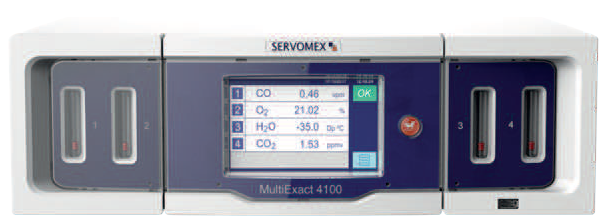
Image Credit: Servomex
The MultiExact 4100 multiple measurement platform has been developed to offer the ideal measurement solution for air separation units. This instrument combines all critical measurements, including % oxygen, trace oxygen, trace carbon dioxide, trace carbon monoxide, and trace nitrous oxide.
Key features of this instrument include:
- The capacity to simultaneously measure up to four gas streams
- Unrivaled operational performance via improved sensor technologies
- Low cost of ownership, including non-depleting, stable sensors that do not require frequent calibration
- Comprehensive digital communications capabilities, including Profibus, Modbus, and Ethernet
SERVOPRO MonoExact DF310E
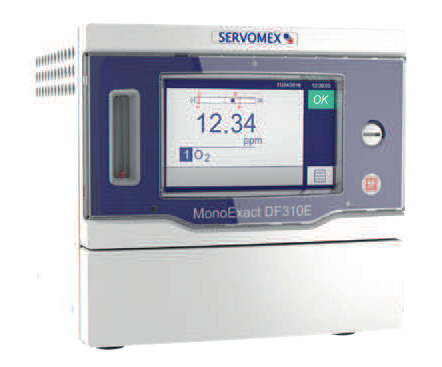
Image Credit: Servomex
The SERVOPRO MonoExact DF310E oxygen analyzer employs the widely recognized Servomex Delta F proprietary non-depleting coulometric sensor technology. This technology boasts a 5 year sensor warranty, no false low readings, and span calibrations that are only required once per year.
The sensor arrives factory-calibrated and does not need calibration as part of its commissioning.
Key features of this instrument include:
- Suitability for ppb, ppm, and % level oxygen measurements
- A rugged compact analyzer available in panel mount, bench mount, and rack mount versions
- Low cost of ownership, with no frequent span calibration requirements or periodic sensor replacement
- Reliable, precise QA measurements with no risk of false low readings due to sensor depletion associated with other electrochemical sensor technologies
SERVOPRO Chroma
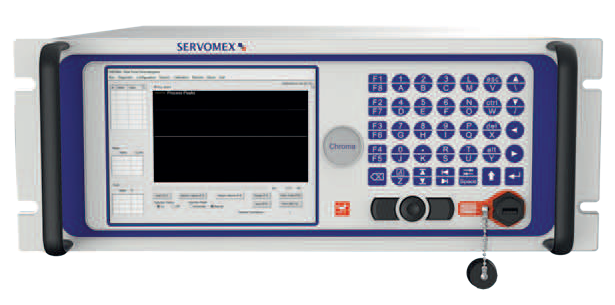
Image Credit: Servomex
The SERVOPRO Chroma multicomponent gas chromatograph leverages plasma technology to measure trace levels of specific impurities found in oxygen, nitrogen, and argon product streams. The Chroma can also be utilized in the measurement of trace nitrogen in crude argon in order to increase argon yield by as much as 5%.
Key features of this instrument include:
- The capacity for trace gas measurements in ppb, ppm, and %
- The ability to detect oxygen, nitrogen, argon, methane, non-methane hydrocarbons, carbon monoxide, carbon dioxide, and hydrogen impurities in pure argon, oxygen, and nitrogen.
- A standalone system with no need for third-party software
- A compact rack-mount 4U configuration
- Easy operation via an electronic platform
- Internet-enabled systems allow remote control and monitoring
SERVOPRO Plasma
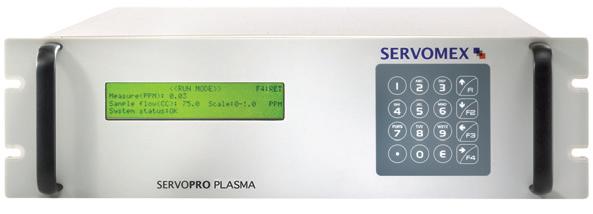
Image Credit: Servomex
The SERVOPRO Plasma plasma emission detector-based analyzer has been designed to continuously measure nitrogen levels in pure argon. It can also be configured to measure nitrogen impurities in pure helium and argon in specialty gas laboratories and gas bottling applications.
Key features of this instrument include:
- Sensitive, stable plasma emission detection
- A solid-state mass flow transducer controller
- Standard factory set to accommodate three measuring ranges
- Automatic range change to ensure optimal output resolution
- Digital communications to enable remote monitoring
SERVOPRO FID
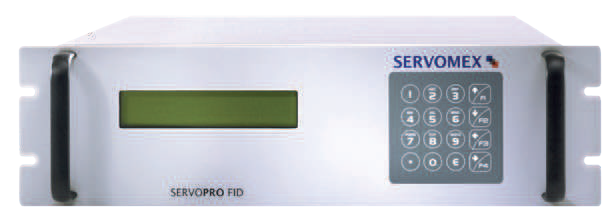
Image Credit: Servomex
The SERVOPRO FID flame ionization detector-based analyzer has been designed to ensure safe operation of cryogenic air separation units by confirming that THC concentrations remain below flammable limits. This instrument can also be used to ensure quality control in pure oxygen, nitrogen, argon, helium, and air.
Key features of this instrument include:
- A reliable, stable flame ionization detector
- Standard factory set to accommodate three measuring ranges with over-range
- Automatic range change to ensure optimal output resolution
- Improved safety due to a flame-out alarm and fuel shut-off valve
- Digital communications capabilities
Acknowledgments
Produced from materials originally authored by Servomex.

This information has been sourced, reviewed and adapted from materials provided by Servomex.
For more information on this source, please visit Servomex.