Global plastic production reached around 400 million tons in 2022, but most discarded plastic is never recycled.¹ An analysis of all plastic produced up to 2015 found that 9% of the waste had been recycled and 12% incinerated, while 79% had gone to landfills or the natural environment.² Yet, there could still be hope.
A study published in July 2026 tested a different route for mixed plastics, converting them into hydrogen while most of their carbon stays behind in solid and liquid residues instead of leaving as carbon dioxide.¹
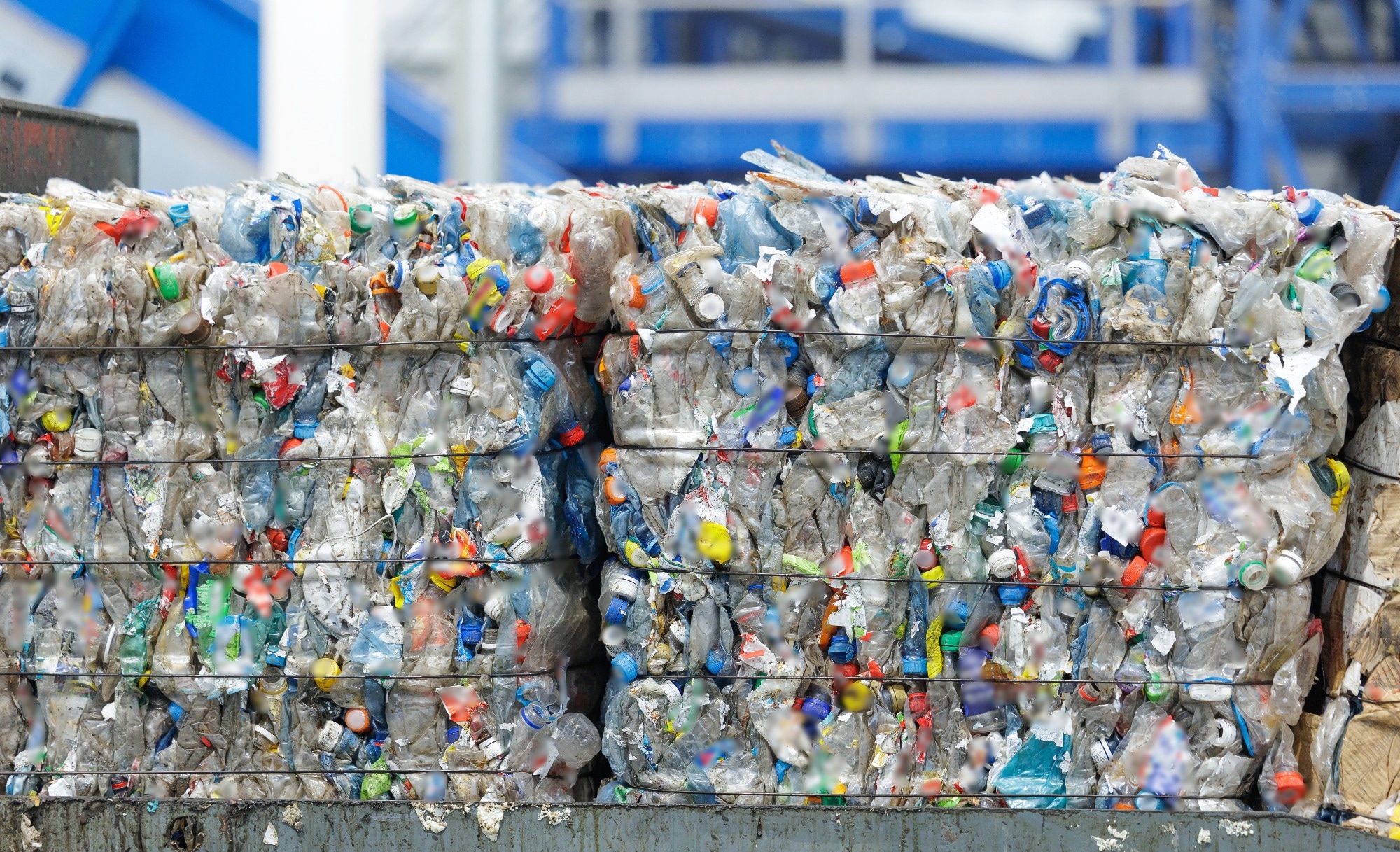
Image Credit: Parilov/Shutterstock.com
A Single-Step Route for Mixed Plastics
Mixed plastic is hard to handle because different polymers normally have to be sorted first, and gasification, the main thermal option that tolerates mixed waste, typically needs 800 to 1000 °C and emits substantial carbon dioxide.1
A team from Ewha Womans University and the University of California, Los Angeles, tested alkaline thermal treatment (ATT), a method run at atmospheric pressure that exposes the plastic to sodium hydroxide and steam as the temperature rises. Polyethylene terephthalate (PET), which contains oxygen, reacted readily, with hydrogen forming from 300 to 400 °C, whereas steam gasification of PET without the hydroxide peaked near 700 °C.1 Polyethylene (PE) and polypropylene (PP) have no oxygen in their structure and showed little reactivity.
The authors’ calculations indicate that hydroxide ions cannot readily attack plain carbon chains but do bind to the oxygen-containing groups that oxidation creates.1 Heating them in air for 50 hours beforehand added oxygen-containing groups to the polymer chains, and under the best conditions the plastics gave 43.7 (PET), 51.9 (PE) and 30.2 (PP) millimoles of hydrogen per gram.1
Oxidation has a cost because it removes material. At 350 °C, polyethylene lost about 74% of its mass, so the best settings after correcting for that loss were roughly 250 °C for PE and 200 °C for PP.1
The team then combined PET, PE and PP in equal parts, using waste plastic from commercial products such as water bottles. Hydrogen yields from the mixture were comparable to those from each plastic alone, and hydrogen appeared in stages near 297, 441 and 573 °C, matching the three polymers in turn.1 Hydrogen made up more than 94% of the gas from oxidized PE and more than 91% from oxidized PP.1
Want to save this article for later? Click here.
Where the Carbon Goes
Sodium hydroxide also traps carbon. The carbon dioxide formed as the plastic that breaks down reacts with it to form solid sodium carbonate, so less of it escapes as gas.1
In the authors’ carbon balance, sodium carbonate held 32% to 44% of the plastic’s carbon, tarry and waxy liquids held 44% to 62%, and under 13% remained as gas or other organic species.1 These two fractions are not equivalent. Earlier work cited by the authors shows that treating sodium carbonate with calcium hydroxide regenerates the sodium hydroxide and fixes the carbon as calcium carbonate, which is less soluble and used in cement, paper and fillers.1 Tar and wax are not a mineral store of carbon, and the authors caution that these products should be interpreted carefully.1
A simplified life cycle assessment compared emissions per kilogram of hydrogen. Steam gasification of PET released about 20.7 kg of carbon dioxide equivalent, compared with 10.9 kg for PET, 8.3 kg for PP, and 4.8 kg for PE under ATT.1 Steam gasification of PE and PP gave even lower hydrogen yields, which the authors say made those cases unviable for hydrogen production because emissions per kilogram were very high.1
The authors cite 8 to 10 kg for steam methane reforming without carbon capture, so the PE and PP results sit below or within that range while PET sits slightly above it.1 They list recycling the sodium hydroxide and using the unwanted hydrocarbon gases as fuel among the ways the figures could improve.1
Why the Timing Matters
Plastics are a hydrogen-rich feedstock, since common polymers are 8% to 14% hydrogen by weight.3 A 2025 review notes that photoreforming and electrocatalysis work mainly on oxygen-containing plastics such as PET, while pyrolysis and gasification can take mixed waste but need high energy inputs and, in gasification, release carbon dioxide.3
The need for alternatives is clear from the hydrogen market, where demand reached almost 100 million tons in 2023, and low-emissions hydrogen supplied less than 1% of it.4 A process that turns an unsorted waste stream into hydrogen at lower temperatures could add to clean supply while reducing the plastic sent to landfill, provided it can be scaled.
What Comes Next
The study is a laboratory demonstration. Each run used 0.05 g of polymer, and the authors note that inert fillers in real waste streams could affect the apparent hydrogen yield.1 Yields were below the theoretical maximum, with reaction selectivities of around 33% for PET, 49% for PE and 41% for PP, which the authors identify as room for optimization.1 The 50-hour oxidation step, the loss of material it causes and the need to recover sodium hydroxide are likely to shape the cost, and the authors say the economic and environmental trade-offs still need to be assessed in later work.1
The paper shows that mixed plastics can yield hydrogen at moderate temperatures without sorting, with most of the carbon retained in solid and liquid residues. Whether that holds for tons of real waste, with sodium hydroxide recycled and the liquid fraction put to use, is what the next stage of research has to settle.
References and Further Reading
- Park, J., Kim, H., Seo, H., Lee, J., Lim, H.-K., Jung, W., Park, A.-H. A., & Kim, W.-J. (2026). Selective and direct hydrogen generation from mixed plastic waste via alkaline thermal treatment with inherent carbon storage. Proceedings of the National Academy of Sciences, 123(28), e2537552123. https://doi.org/10.1073/pnas.2537552123
- Geyer, R., Jambeck, J. R., & Law, K. L. (2017). Production, use, and fate of all plastics ever made. Science Advances, 3(7), e1700782. https://doi.org/10.1126/sciadv.1700782
- Niu, F., Wu, Z., Chen, D., Huang, Y., Ordomsky, V. V., Khodakov, A. Y., & Van Geem, K. M. (2025). State-of-the-art and perspectives of hydrogen generation from waste plastics. Chemical Society Reviews, 54(10), 4948–4972. https://doi.org/10.1039/D4CS00604F
- International Energy Agency. (2024). Global Hydrogen Review 2024. IEA, Paris. https://www.iea.org/reports/global-hydrogen-review-2024
Disclaimer: The views expressed here are those of the author expressed in their private capacity and do not necessarily represent the views of AZoM.com Limited T/A AZoNetwork the owner and operator of this website. This disclaimer forms part of the Terms and conditions of use of this website.