Researchers have developed a new method to track biochar decomposition in soil using radioactive carbon-14 (¹4C) from 1960s nuclear weapons testing. The study found that less than 0.4% of biochar carbon was released over one year, supporting its potential for long-term carbon storage and offering a promising tool for assessing biochar stability.
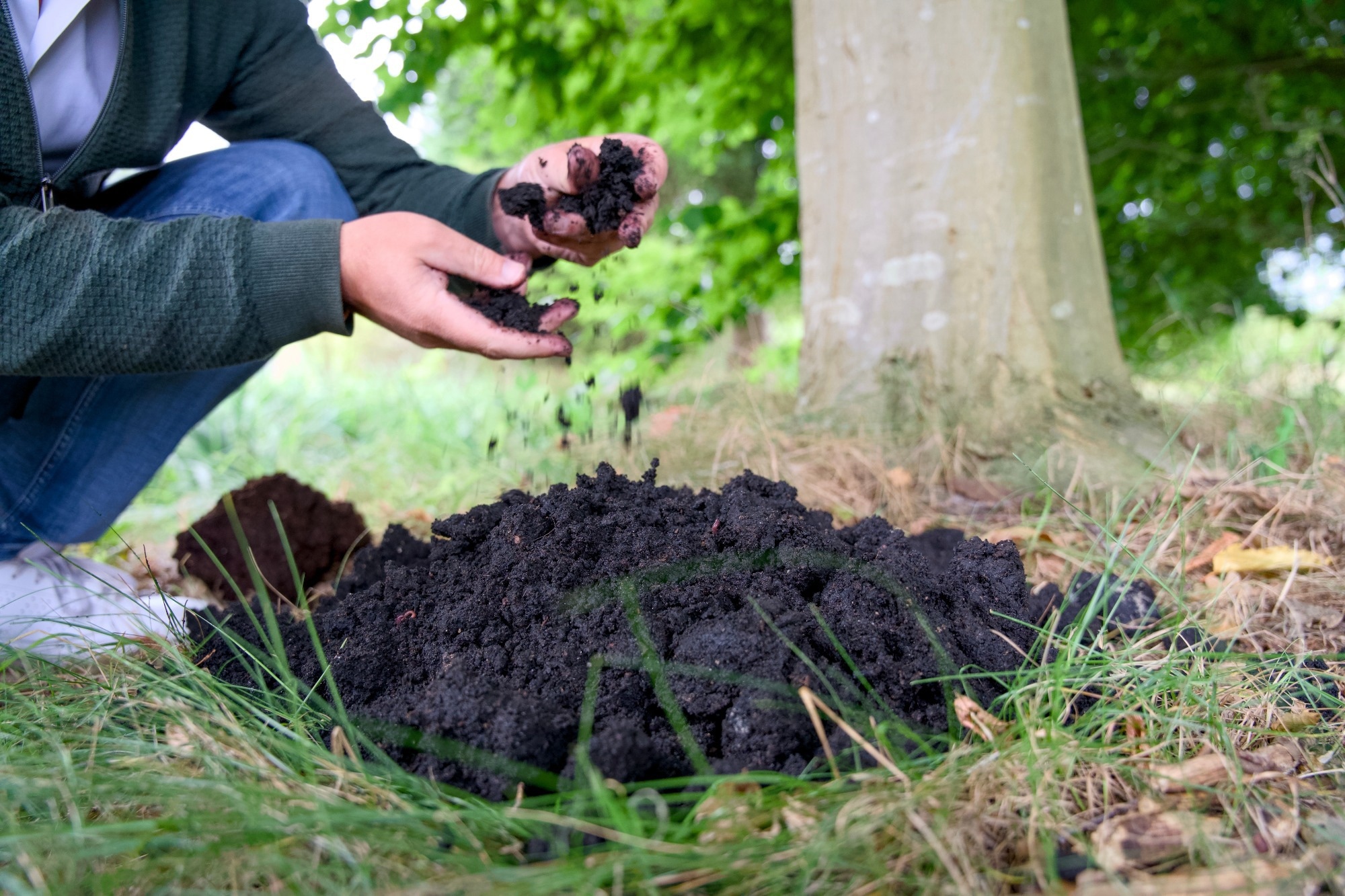
Study: Bomb 14C for tracing biochar mineralization in soil. Image Credit: Rene Notenbomer/Shutterstock.com
Biochar C Mineralization in Soil
Biochar can potentially enhance the terrestrial carbon (C) sink on a global scale with 0.7–1.8 Pg carbon dioxide–C (CO2–C) equivalents each year, corresponding to approximately 6–16% of existing anthropogenic emissions of C. Thus, an improved understanding of biochar C stability in soil is necessary for soil C sequestration.
However, investigating biochar C dynamics in soil remains challenging due to the difficulty of distinguishing CO2 released through biochar C mineralization from CO2 derived from other soil C sources, the high persistence of biochar, which results in a relatively small contribution of biochar-derived CO2 to overall soil CO2 fluxes, and the non-additive nature of CO2 emissions from biochar and other soil C sources.
Researchers have used various experimental approaches to differentiate biochar C from soil C sources. For instance, ¹4C-labeled or ¹³C- or ¹³C-depleted biomass has been used to produce biochar.
Yet, advanced facilities are required to achieve uniform isotope enrichment in feedstock for laboratory labeling, which is time-consuming and expensive.
Want to save this article for later? Click here.
Bomb 14C
A peak in atmospheric ¹4C abundance occurred around 1964 due to nuclear bomb tests in the 1950s and 1960s; thereafter, it decreased gradually. By 2020, the level of ¹4C had reduced to almost pre-modern levels.
This spike in ¹4C enables the use of ¹4C derived from bombs as a tracer. Tree rings archive records of atmospheric ¹4C, and the rings formed throughout the bomb pulse are considered ¹4C-labeled in situ. Thus, ¹4C-labeled biochar can be obtained from this wood, although the level of enrichment is low compared to artificially labeled materials.
Bomb 14C for Tracing Biochar Mineralization
In this work, researchers developed and evaluated an approach to quantify mineralization of biochar in soil using bomb ¹4C in tree rings as a tracer. Specifically, they used the higher levels of ¹4C in wood from tree rings formed between 1964 and 1967 to estimate the biochar C proportion in mineralized soil.
Using wood from the tree rings enriched with ¹4C as feedstock, researchers produced biochar, which was then used in a mineralization test capturing the emitted CO2.
The authors selected six 70-year-old tree trunks, including three Scots pine and three Norway spruce, with concentric year rings. They cut a 50 cm piece from each selected trunk. However, one pine trunk was later discarded after inspection because of an irregular tree-ring pattern.
After removing the outer layers by turning, the wood formed during 1964 to 1967 was cut out through continued turning and preserved as ¹4C-enriched wood material.
Study Methodology
Under a nitrogen atmosphere, biochar was produced from each ¹4C-enriched wood sample in a muffle furnace with a maximum treatment temperature of 550 °C. Accelerator mass spectrometry was then used to determine the ¹4C abundance of five biochars.
The biochar feedstock from one spruce sample had the highest ¹4C abundance and was selected to produce two biochars at 650 °C (BC650) and 400 °C (BC400).
The yields of BC650 and BC400 were 13% and 28%, with 81.6 wt% and 69.6 wt% organic C content, and 0.28 and 0.55 hydrogen/organic C molar ratio, respectively. Cambisol soil was utilized for incubation, and the topsoil texture was categorized as loamy sand.
Subsequently, BC650 and BC400 were added at 2% of the dry soil mass. Researchers also included a control soil without biochar.
How Effective Is This Method?
Biochar synthesized from wood formed during 1964–1967 averaged 61.7 pMC higher than bulk soil organic matter (SOM). The abundance of ¹4C in the most enriched tree sample (172.9 pMC) almost matched the average concentration of atmospheric ¹4C between 1964 and 1967 in the Northern Hemisphere (173.8 pMC).
Soil–biochar mixtures consistently exhibited higher ¹4CO2 abundances than control soil (p < 0.0001) when ¹4C-enriched biochar was incubated in soil. At a 2% biochar application rate, researchers estimated that biochar contributed 8.3–11.4% of mineralized CO2-C during the first two weeks, then declining to 2.3–7.5% during later stages.
This finding was consistent with studies that used isotopically labeled biochar or ¹³C natural abundance. Biochar addition to soil influenced the mineralization of soil organic carbon (SOC), either by suppressing decomposition (negative priming) or enhancing decomposition (positive priming), thereby affecting biochar’s long-term C sequestration potential in soil.
Here, researchers distinguished SOC-derived C mineralization from that of biochar. After one year of incubation, BC650 induced negative priming on SOC mineralization, whereas BC400 produced no significant priming effect.
In conclusion, the findings demonstrated that bomb ¹4C biochar-based methods can trace biochar C dynamics in soils and improve the understanding of biochar C sequestration.
What Do the Findings Show?
The findings highlight biochar's potential as a long-term carbon storage solution, particularly its ability to retain carbon in soils while resisting microbial decomposition.
With less than 0.4% of biochar carbon mineralized over the one-year incubation period, the study provides further evidence of biochar's stability, especially when produced at higher pyrolysis temperatures.
The negative priming effect observed with BC650 also suggests that certain biochars may reduce the decomposition of existing soil organic carbon, potentially enhancing their overall carbon sequestration benefits.
Although longer-term field studies are needed to determine how biochar stability varies across different soils and environmental conditions, the bomb ¹4C tracing method offers a valuable tool for measuring biochar decomposition more precisely.
By improving understanding of how biochar behaves in soil over time, this approach could help researchers assess its carbon storage potential more reliably and support its wider use in climate change mitigation strategies.
Journal Reference
Li, H., Cederlund, H., Azzi, E. S., Sundberg, C., & Karltun, E. (2026). Bomb 14C for tracing biochar mineralization in soil. Radiocarbon, 68(5), 1146-1154. DOI:10.1017/RDC.2026.10247, https://www.cambridge.org/core/journals/radiocarbon/article/bomb-14c-for-tracing-biochar-mineralization-in-soil/B78C2B6C402E4191ED425B25F32CB2C6
Disclaimer: The views expressed here are those of the author expressed in their private capacity and do not necessarily represent the views of AZoM.com Limited T/A AZoNetwork the owner and operator of this website. This disclaimer forms part of the Terms and conditions of use of this website.