A technology used in the Netherlands is seeing heat captured by synthetic turf sports pitches for the first time, with a single field able to heat up to 300 homes for a year with green energy.
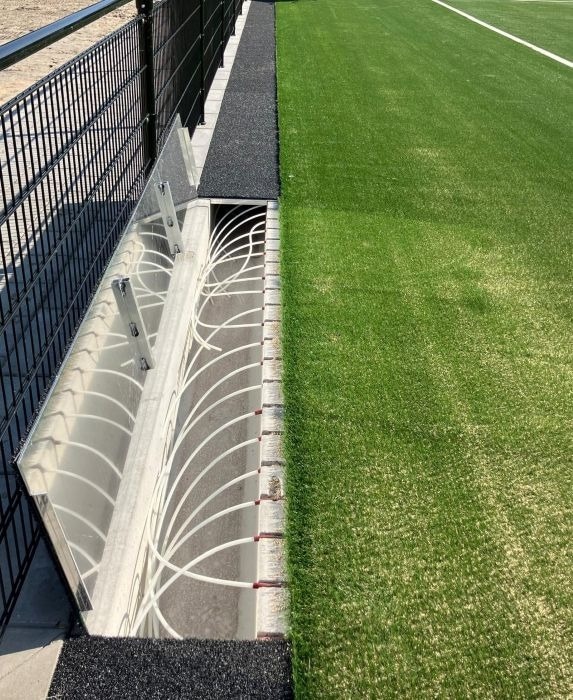 Image Credit: EMEA Synthetic Turf Council (ESTC)
The development contributes to a wider sustainability commitment from the Dutch sports sector, which aims to achieve a 95% reduction in carbon emissions by 2050, in line with the Roadmap for Improving Sustainability in Sport and the wider Dutch Climate Agreement.
As part of the commitment, the Sustainable Sports Facilities team within the Knowledge Centre for Sport & Physical Activity (Kenniscentrum Sport & Bewegen) is, in collaboration with other organizations, supporting municipalities and local sports clubs to raise awareness of practical solutions, such as heat collector fields, that can help reduce carbon emissions, contribute to regional sustainability targets, and provide a benefit to the local community.
The fields function by capturing the heat from the surface of synthetic turf, and then distributing it via underground pipes below the pitch. This heat can be used directly or stored to provide a consistent source of energy throughout the year. This has the added benefit of cooling down the surface of the pitch, helping to ensure a safe and comfortable playing surface for users.
Leander Lignac, Specialist Sustainable Sports Facilities at the Knowledge Centre for Sport & Physical Activity, said: “As an independent and neutral organization, one of our goals is making owners of sports facilities aware of the possibilities within sustainability. Turning synthetic turf sports pitches into a source of green energy is all about impact – using a single space in multiple ways to solve many challenges at once.
“Space in the Netherlands is sparse, especially in the cities – so when it’s possible to use conveniently located pitches not just for sports, but for sustainability goals too, these facilities become more future proof. While this technology is not yet widespread, it has the potential to deliver a significant reduction in carbon emissions when scaled up.
“Ultimately, the sports sector needs to be future proof, and as part of that journey, it is our job to make municipalities and local sports clubs aware of these solutions to help them be realized across the Netherlands.”
To date, heat collector fields have been installed in Eindhoven, Zaanstad, Gouda, and The Hague. The heat captured from each field is being used to supply a variety of nearby buildings – from sports facilities, homes, and swimming pools to primary schools and daycare centers.
With at least 1,250 synthetic turf football pitches across the Netherlands, the technology has the potential to cut national CO2 emissions by up to 0.45 megatons per year, with further opportunity for multi-use synthetic turf pitches. The municipalities of Amsterdam and Haarlem, together with SRO, are already targeting the renewal of more than 250 synthetic pitches as part of the Scale Up initiative. The heat collector field technology will be used in the project wherever it fits.
Stefan Diderich, Director General/CEO at EMEA Synthetic Turf Council (ESTC), said: “This technology is a prime example of the wider benefits that are being delivered through synthetic turf every day. These fields not only provide a high-quality playing surface, but a source of clean, renewable energy that communities can be built around.
“We not only hope for this technology to be scaled up across the Netherlands, but for other countries to look and learn from this, as this has the potential to deliver an extraordinary amount of good on a global scale.”