As offshore wind farms multiply along the U.S. East Coast, scientists are tackling a pressing question of whether the transition to clean energy can move forward without putting one of the world's rarest whales at greater risk. A new study published in Nature Climate Change suggests the answer is yes.
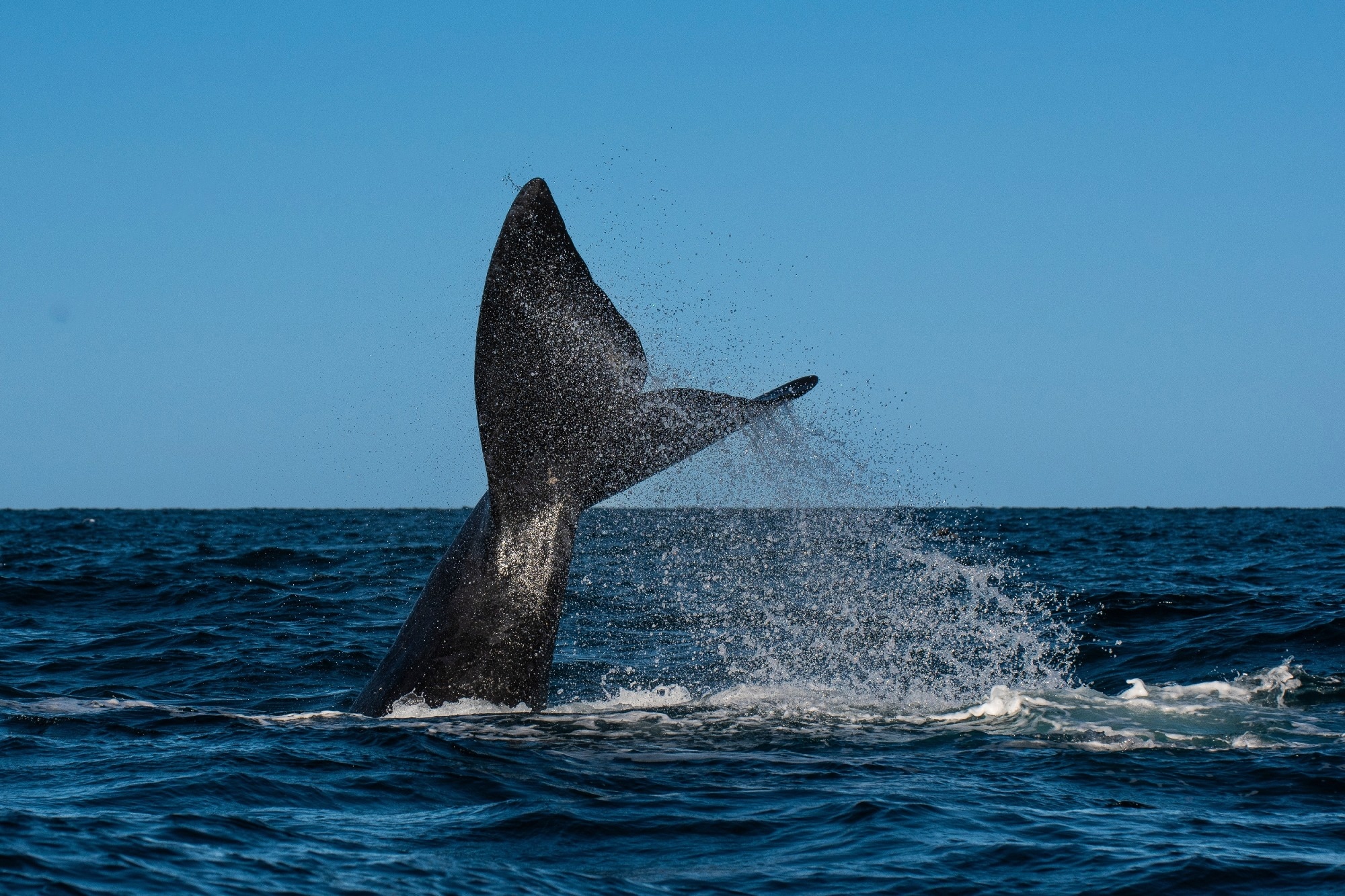
Study: Balancing marine species conservation with cost-effective renewable energy development. Image Credit: Foto 4440/Shutterstock.com
Researchers found that combining carefully timed construction schedules with advanced underwater noise-reduction technology can dramatically reduce the impact of offshore wind development on critically endangered North Atlantic right whales, while adding only a modest increase to project costs. The findings provide a practical roadmap for balancing renewable energy expansion with the protection of vulnerable marine wildlife in a changing climate.
Protecting Marine Wildlife as Offshore Wind Expands
Offshore wind is becoming an important part of the global transition to low-carbon energy. Global offshore wind capacity increased from 8503 MW in 2014 to 72,663 MW in 2023. The United States also has extensive coastal waters with suitable wind resources. However, expanding offshore wind infrastructure presents an environmental challenge. Projects that help address climate change can also affect sensitive marine ecosystems.
Developers install offshore wind turbines by driving large monopile foundations into the seabed. This process generates intense underwater noise that can injure marine mammals or disrupt feeding, migration, and breeding. These risks are particularly important for the critically endangered North Atlantic right whales (Eubalaena glacialis).
Climate change further complicates conservation efforts by shifting when and where right whales occur. Offshore wind projects have traditionally scheduled construction around historical whale migration patterns to reduce encounters. However, recent surveys in southern New England show that right whales now occur more frequently in areas and seasons once considered to have low whale abundance.
These shifts in right whale distribution make traditional mitigation strategies less reliable. To address this challenge, the researchers developed a framework that balances whale protection with offshore wind development costs. The framework identifies mitigation measures that can reduce whale exposure to construction noise while limiting additional costs for developers.
Want to save for later? Click here.
Modeling Whale Distribution and Wind Farm Construction
The researchers developed a density surface model to predict North Atlantic right whale distribution in southern New England. They used aerial survey data collected between 2011 and 2020. The dataset covered 137 surveys and 14,410 survey segments, with 600 right whales recorded across 70,074 km of survey effort.
The team examined how environmental conditions influenced whale density. These factors included sea surface temperature, salinity, water depth, and distance from important depth contours. The best-performing model linked whale density to salinity, seasonal changes in sea surface temperature, and distance from the 30-m isobath. The model explained 33.4% of the observed variation and achieved an area under the curve value of 0.89.
The team then combined these whale-density predictions with simulations of offshore wind construction. Each simulated campaign involved installing 70 monopile foundations within an area of approximately 468 km². The simulations also considered practical construction constraints, including wind speed, visibility, daylight hours, and seasonal restrictions. The researchers compared 10 mitigation scenarios using different construction periods and noise-control measures. The team then estimated how many whales could experience Level A noise exposure, which indicates potential injury, or Level B exposure, which can cause behavioral disturbance.
Seasonal Restrictions and Noise Control Reduce Whale Exposure
The model revealed influences of seasonal changes in right whale distribution. Whale density was generally highest during winter and spring. In winter, whales occurred mainly around the 30-m and 40-m isobaths and Nantucket Shoals. Their distribution expanded across the study area during spring before declining in summer and reaching its lowest levels in autumn.
The researchers observed changes over time, such as summer whale density along the eastern side of the 30-m isobath and Nantucket Shoals increasing from 2014 onward. This shift shows why construction schedules based only on historical migration patterns may become less effective as climate change alters marine habitats.
The trade-off analysis showed that removing seasonal restrictions offered little advantage. Year-round pile-driving increased predicted Level A whale exposure by 236% compared with the current May–December construction schedule. It also added $6.44 million to estimated project costs because poor winter weather increased construction delays. Adjusting the construction season offered better protection. Limiting pile-driving to June–December reduced predicted Level A exposure by 24%. Both options increased costs by $6.44 million compared with the current schedule.
Additional noise attenuation delivered greater conservation benefits. Adding a double big bubble curtain to the current construction schedule reduced predicted Level A exposure by 66% at an additional cost of $7 million. Combining the same system with June–December or June–November construction reduced exposure by 74%.
The additional $7 million required for enhanced noise attenuation represents about 7% of the estimated $95.795 million cost of the current construction scenario. This relatively modest increase could therefore deliver substantial conservation benefits. The researchers also tested different assumptions about how far pile-driving noise travels underwater. These changes affected the estimated number of whales exposed but did not alter the relative performance of the mitigation strategies.
Toward Wildlife-Conscious Offshore Wind Development
The findings show that offshore wind development can advance alongside marine conservation. Strategic construction schedules and effective noise attenuation can substantially reduce risks to North Atlantic right whales while adding relatively modest costs to offshore wind projects. The study also emphasizes the need for up-to-date ecological data when planning offshore wind construction.
Climate change is shifting marine species distributions, making historical migration patterns less reliable. Regular monitoring and high-resolution distribution models can help developers identify construction periods with lower risks to wildlife. However, the framework focuses specifically on right whale exposure to pile-driving noise. It does not consider other potential impacts, such as vessel strikes or changes in habitat and prey availability.
Researchers can adapt the approach to other marine species, renewable energy projects, and ocean industries. It can also help developers and regulators compare the conservation benefits of mitigation measures with their financial costs. Combining ecological monitoring, adaptive construction schedules, and effective noise control can support renewable energy development while reducing risks to vulnerable marine species.
Journal Reference
Ganley, L. C., Redfern, J. V., et al. (2026). Balancing marine species conservation with cost-effective renewable energy development. Nature Climate Change. DOI: 10.1038/s41558-026-02696-9.
https://www.nature.com/articles/s41558-026-02696-9
Disclaimer: The views expressed here are those of the author expressed in their private capacity and do not necessarily represent the views of AZoM.com Limited T/A AZoNetwork the owner and operator of this website. This disclaimer forms part of the Terms and conditions of use of this website.