Infrastructure services leader, Colas Rail UK, is rolling out hydrogen-powered engine carbon clean* across its 31-strong tamper fleet – after successful trials on two assets at their Rugby depot generated fuel and emissions savings of over 13%.
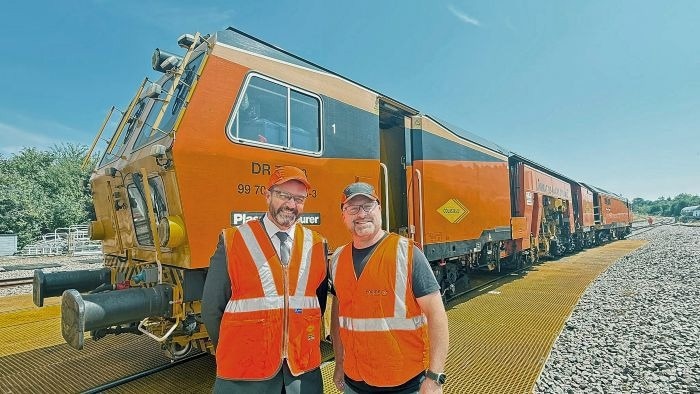 Pic shows l to r: Paul Conway and Daniel Sturgeon. Image Credit: Colas Rail UK
Taking these efficiencies a step further, Colas is also the first company to take advantage of the new Engine Carbon Clean (ECC) subscription solution, whereby they have their own ECC generators and can perform the cleans themselves – anywhere in the country and on demand – as part of their maintenance and servicing schedules.
The two trial tampers were cleaned four times for three hours each visit and the Colas engineering department was able to reduce RPMs in each mode – as removal of the carbon build up inside the engines allows them to breathe again and achieve better combustion. In working max mode, this was 1,995 RPM reduced to 1,520 RPM to perform the same tasks.
This means across the 31 tamper assets, over 550 tons of CO2e have been forecasted to be saved per year once the annual engine carbon cleans are performed.
Daniel Ditri, Head of Energy & Carbon at Colas Rail UK, explains: “Decarbonization is a business priority and driving this is a clear, data-led strategy. We are committed to the globally recognized Science Based Targets initiative, aligning with Network Rail’s ambitions – in this instance our target is a 46.5% reduction in Scope 1 and 2 emissions by 2030 – and working with SME innovator Engine Carbon Clean delivers tangible CO2e and cost savings to that end. Replacing assets too early is not sustainable, so we are focused on maximizing the performance of what we already have.”
Paul Conway, Head of Engineering & Compliance for Colas Rail Services, says: “Over 13% CO2e and fuel savings represents a strong and attractive business case. This easily scalable and non-intrusive solution has now been embedded into our tamper maintenance strategy, with potential to quickly expand across our wider fleet and supply chain – helping us drive a cleaner, more efficient future for rail.”
Daniel Sturgeon, Head of Data and Business Development at Engine Carbon Clean, adds: “It’s gratifying working with an ESG-savvy company like the team at Colas Rail because their adherence to circular economy protocols and positive position on reducing emissions and fuel consumption matches our own. Our simple and practical innovation is a quick win, delivering measurable reductions today – especially for operators navigating the challenging gap between ambitious climate targets and operational reality.”
This collaboration began in 2025 when the French innovation team chose Engine Carbon Clean to win an ESG-related grant as part of their internal Innoboost competition, which was sponsored by the CEO of Colas Rail Ltd, Jean-Pierre Bertrand.
Subsequently, the Colas Freight division has also engaged with Engine Carbon Clean to speed up the timeline of trials on the locomotive fleet, starting with two Class 37 locos, as based on the savings level of results from the tampers, projected reductions of over 2,800 tons of CO2 per year could be secured.
View the Colas Rail UK ECC journey (video 1min, 28 secs) at: https://youtu.be/y-Uw_VMYwBQ?is=IwLswCc00bmZflZm
*Engine Carbon Clean, from Advanced Hydrogen Technology Group (AHT), is an innovative and patented on-demand hydrogen generator technology that cleans combustion engines internally by removing carbon build up. Oxyhydrogen gas is piped into the air intake and the engine sucks in what it needs to ‘pop’ the carbon off – significantly improving fuel efficiency and reducing toxic emissions, including CO2, CO, NOx, and N2O.
The removal of the carbon build up inside the engine allows it to breathe – this in turn allows for better combustion, which means revolutions per minute (RPM) can return back to manufacturer’s recommended levels and optimal efficiency.
Hydrogen is a non-corrosive gas, plus no chemicals or harmful additives are used, there is no storage of compressed hydrogen involved, hydrogen isn’t forced or injected into the engine, plus there is no superheating of the engine to burn off the carbon. As all combustible fuels create carbon, it works on diesel and petrol, HVO, CNG, LNG and other biofuels – plus as a modular system, it also cleans all sizes and types of engine.
ECC tracks CO2 levels with an ISO calibrated emissions tester and records from baseline and at post fourth clean, which also indicates the vehicles fuel reduction at idle. Because CO2 and fuel efficiency are linked, a measurable reduction in emissions and a decrease in fuel consumption will always follow.
Innoboost : discover the Engin Carbon Clean
Innoboost : discover the Engin Carbon Clean. Video Credit: Colas Rail UK