Western Sydney University researchers have been awarded over $12.5 million by the NSW Environmental Trust to lead a major research initiative that will help safeguard some of NSW’s most important ecosystems from the impact of climate change.
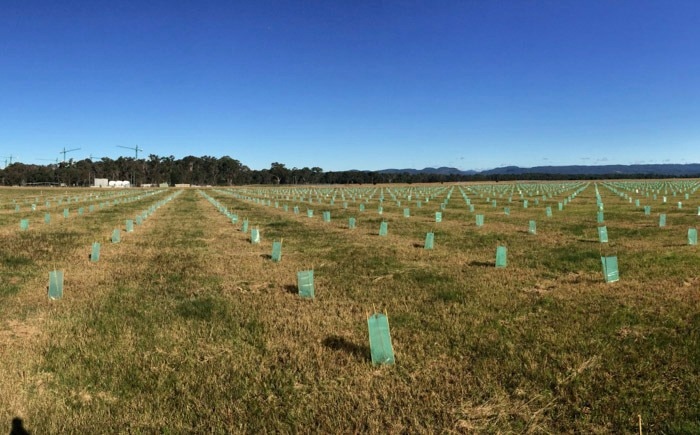 Field Plantings. Image Credit: Paul Rymer
The Ecosystem Diversity and Climate Adaptation Trials will generate the experimental evidence, partnerships, infrastructure and decision support tools required to deliver climate informed restoration of NSW grassy woodlands.
It is the largest research grant awarded to Western Sydney University in the past ten years and will be led out of the University’s Hawkesbury Institute for the Environment, one of the world’s leading research institutes for terrestrial ecology and climate change science.
The project focuses on the iconic grassy woodlands of south-eastern Australia, characterised by open eucalypt canopies and highly diverse understory vegetation. These ecosystems have been heavily cleared and degraded, threatening the loss of biodiversity and ecosystem function in regional communities.
Running from 2026 to 2034, the project will build practical tools to restore natural ecosystems with biodiversity, ecosystem services and resilience to climate change. The trials will produce climate-ready seed for iconic eucalypts and wattles, as well as the diverse ground cover, supporting future landscape restoration.
Led by a team at Western Sydney University the project will bring together partners from universities, government, industry, Landcare, Aboriginal groups, and regional communities, and leverage National Collaborative Research Infrastructure Strategy facilities.
Chief Investigator Associate Professor Paul Rymer from the University’s Hawkesbury Institute for the Environment (HIE) said the project’s strength was it being co-designed with community groups and industry partners to quantify species climate adaptation and ecosystems capacity to respond to climate change.
“There is an urgent need to develop robust approaches to ecosystem restoration to ensure their long-term viability, the biodiversity they support and the services they provide, including cultural connections,” said Associate Professor Rymer.
“The outcomes will be translated using dedicated funds for communications and tools developed for uptake by policy makers and land managers to improve the success of nature-based solutions under climate change.”
The Western Sydney University team consists of Associate Professor Paul Rymer, Professor Mark Tjoelker, Professor Rachael Gallagher, Professor Uffe Nielsen, Distinguished Professor Belinda Medlyn, Dr Laura Williams (all from HIE), Associate Professor Neil Perry (School of Business), Dr Yi Guo and Dr Hao Wu (School of Computer, Data and Mathematical Sciences), and Dr Kate Richards (School of Arts).
Vice-Chancellor and President, Distinguished Professor George Williams AO, offered his congratulations to the interdisciplinary team of researchers spanning biology, computer science, business and the arts.
“This flagship research project demonstrates the power of interdisciplinary research at Western Sydney University in supporting climate resilience into the future. We’re proud that Associate Professor Rymer and his team, together with their collaborators and partners, will lead this critical adaptation trials project with significant support from the NSW Environmental Trust,” said Professor Williams.
The project will involve surveys of remnant vegetation to collect seed with genetic diversity from across south-eastern Australia to model climate adaptation and vulnerability, alongside planting trials to assess performance and evaluate broader outcomes.
Researchers will test species diversity and alternate provenancing strategies for the establishment of functional ecosystems that support carbon sequestration, habitat, and pollination.
The aim is to establish self-sustaining populations that can provide a source of climate-ready seed for restoration at a landscape scale.
Researchers will also develop a ‘knowledge commons’ with web-based tools to help land managers confidently assess the costs, outcomes, and co-benefits of alternative restoration strategies for grassy woodlands.
The Climate Adaptation Trials will be established with conservation agreements, securing a broad range of co-benefits with carbon, biodiversity and seed production with environmental, social and economic benefits for Aboriginal and Landcare groups, regional and rural communities.
The NSW Environmental Trust’s funding reflects its new strategy to prioritise long-term initiatives addressing biodiversity conservation, climate adaptation, river health, Aboriginal-led natural resource management and ecosystem restoration.