A new report ‘England’s Ice Age Survivor: Conserving Arctic charr in the Lake District’ is published today - 26th November - by the Freshwater Biological Association - as part of the Lake District Charr Recovery and Management (LD-CHARM) partnership. The report provides further scientific evidence that Arctic charr are still present in Windermere but are in serious decline with the species facing extinction in Windermere unless urgent action is taken to improve water quality and breeding habitat.
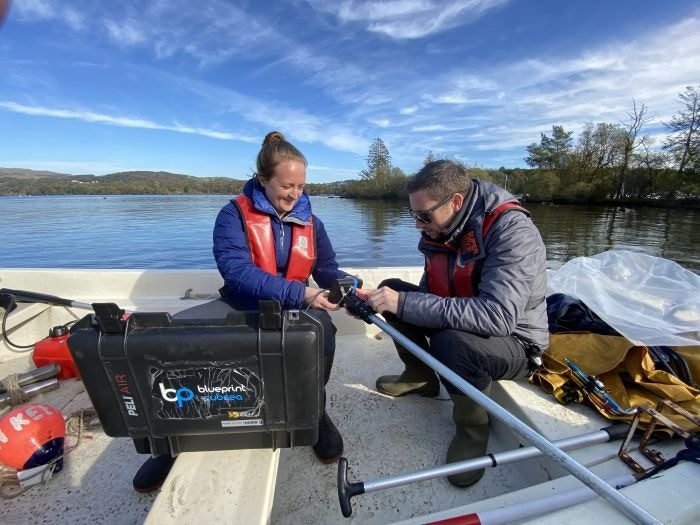 Image Credit: Freshwater Biological Association
Key research findings include:
- No Arctic charr detected at historic spring spawning sites in Windermere or in the South Basin of Windermere.
- Fewer detections of Arctic charr and poorer eDNA signals in Windermere in 2025 compared to 2017.
- Spawning habitat quality has declined markedly since 2017 with silt and algae increasing.
- Introduced fish species are on the rise with ruffe, roach and bream more abundant and widespread than in 2017.
- Most Lake District lakes contain their own, very genetically distinct, population of Arctic charr. Within Windermere, autumn and spring spawners are also genetically separate lineages. The charr in Thirlmere likely originated from 20th century transplants of Windermere spring spawners.
Research Methodology
The research was funded by Natural England's Species Recovery Programme. It combined underwater photography, hydroacoustics (using sound waves to measure the hardness of spawning ground substrate), and examination of fish DNA in the water (environmental DNA, or eDNA) to allow scientists to assess the quality of Arctic charr spawning grounds and see whether charr were attempting to breed there. In Windermere there are separate autumn (November – December) and spring (January – March) spawning populations, with no recorded interbreeding between the two, but there is concern that the spring populations and those in the South Basin of the lake have declined in recent years. To investigate this, known and potential spawning grounds in Windermere were surveyed to test for presence of Arctic charr at breeding grounds and nearby waterbodies with historical or anecdotal evidence of charr. By comparing these results with previous surveys in 2017, the study asked how conditions and populations have changed over time. Researchers also used the FBA’s 80-year old archive to genetically analyze Arctic charr scales to explore whether Windermere autumn and spring spawners are distinct populations and how charr differ among Lake District lakes.
What is the Cause of the Decline in Arctic Charr in Windermere?
The three key pressures facing the Arctic charr in Windermere are:
- Nutrient enrichment, caused by a combination of sewage from waste water treatment works and poorly managed private systems, and land uses such as agriculture and forestry.
- Invasive species such as ruffe and roach, which compete for food and predate charr eggs and juvenile fish.
- Rising water temperatures caused by climate change. Arctic charr, as a cold water fish, are sensitive to temperature change, particularly during their early life stages.
What Next to Support Arctic Charr Populations in Windermere?
- Reducing pollutants including sewage and run-off from the land in Windermere must be a priority.
- Restoring clean, hard spawning substrates is a high priority for Arctic charr recovery in Windermere.
- Preventing further introductions of introduced species which directly impact Arctic charr through increased awareness and improved biosecurity.
- Confirming whether the Windermere spring spawning population still exists and whether any Arctic charr still breed in the south basin.
The LD-CHARM project has created a coordinated approach for Arctic charr conservation in England and has secured three years of additional funding through Natural England's Species Recovery Programme to assess the other populations in the Lake District. This will help us to better understand the pressures facing England’s Arctic charr and the necessary conservation priorities.
Project lead Dr. Louise Lavictoire, Head of Science at the FBA, said:
“Our action-focussed research has shown very clearly that we are at risk of losing Arctic charr from Windermere completely. The species is facing multiple pressures and our LD-CHARM research gives us the evidence, data and sense of urgency to take collective action to protect this ancient fish species before it’s too late.”
Dr Victoria Pritchard from University of Highlands and Islands said:
“The FBA’s huge archive of Arctic charr scales is an amazing resource that enables us to look at how the genetic composition of Lake District charr has changed over time”.
Dr Stephen Thackeray, Head of Aquatic Ecosystems at the UK Centre for Ecology & Hydrology (UKCEH), said:
“Freshwater biodiversity is under increasing pressure at a global scale, and Windermere's Arctic charr populations are a local example of this bigger picture. To understand the multiple threats facing freshwater wildlife, we must continue to work collaboratively, integrating established and novel research methods, which then guides management action.”
Dave Ottewell, Freshwater Fish and Fisheries Senior Specialist for Natural England, said:
“The Arctic charr is an iconic species, native to Cumbria, and a living link to the end of the last Ice Age. We know that good science and effective partnerships can bring our most threatened species back from the brink and this includes Arctic charr. LD-CHARM's vital research will help us protect and restore charr in Windermere and lakes across the Lake District. We're delighted to have supported the project through our Species Recovery Programme in 2025-2026, and we're continuing our funding until March 2029 to reverse the decline of this remarkable fish.”
The Arctic charr is one of England's oldest native freshwater fish species, having inhabited the Lake District since the end of the last Ice Age over 11,000 years ago. The species is an iconic part of the region's natural heritage and an important indicator of healthy freshwater ecosystems. Once present in eleven Lake District lakes, they are now restricted to just eight surviving populations, with three already lost.