How Does A Hydrogen Fuel Cell Work?
A Short Timeline
Hydrogen Fuel Cell Case Studies
Challenges
Use Around the World
What the Future Looks Like
References and Further Reading
Home fuel cells already supply electricity and hot water to households, mainly in Japan, where roughly 420,000 residential systems were in place by the end of 2021.1 Such a device generates power through a chemical reaction rather than by burning fuel. This article covers how the technology works, its history, where it is used, the obstacles it faces, and its likely direction.
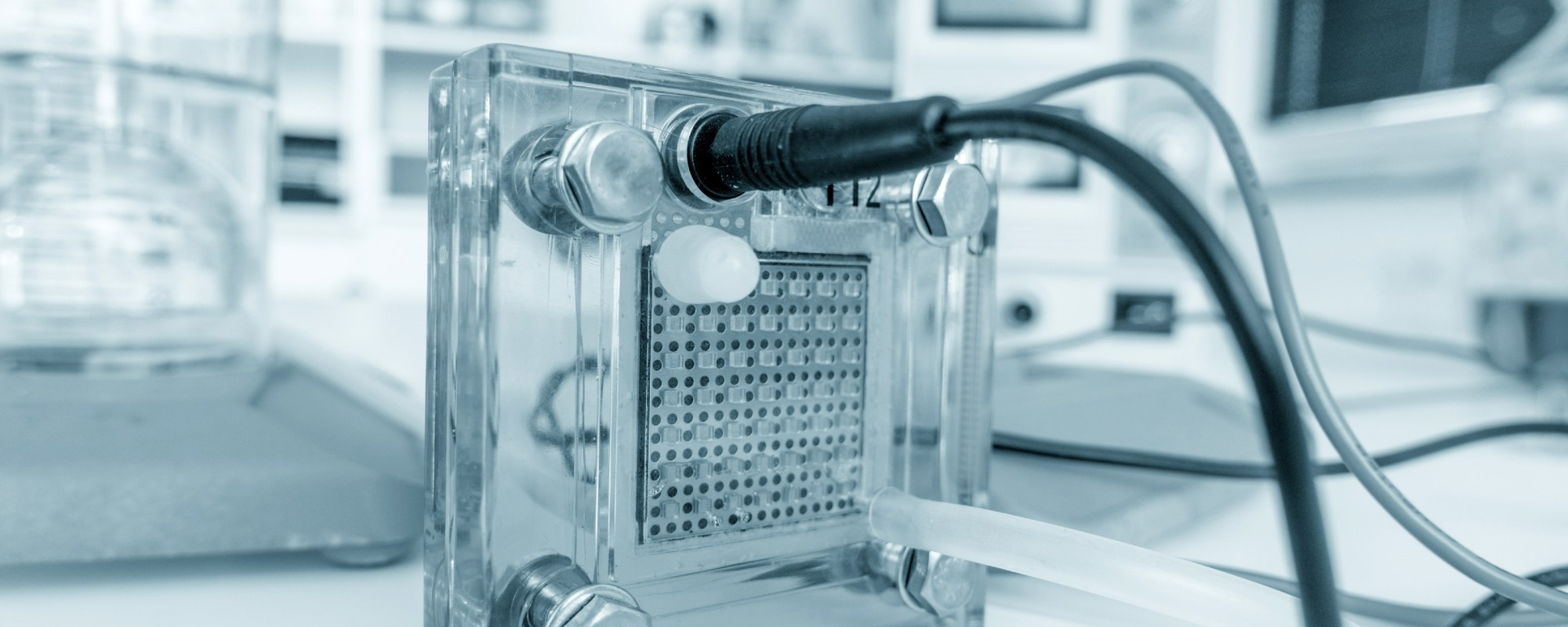
Image Credit: luchschenF/Shutterstock.com
How Does A Hydrogen Fuel Cell Work?
Inside a fuel cell, hydrogen and oxygen from ambient air react electrochemically, producing an electric current, heat, and water.
Japan’s Ene-Farm obtains its hydrogen from the city gas supply and sends the waste heat to a hot water store.2 Since the electricity is produced inside the home, nothing is lost in grid transmission.2
A Panasonic unit unveiled in February 2026 illustrates the design. Gas, either methane or LPG, passes through a fuel processor that frees the hydrogen, which is then fed to the cell stack. In the city gas version, electrical output ranges from 200 to 700 W at a rated efficiency of 41% (lower heating value basis).3 Captured heat warms a water tank of roughly 100 liters, taking rated total efficiency to 98% for methane. An auxiliary burner covers any hot water demand beyond what the cell provides, and during blackouts the system can deliver up to 500 W.3
A Short Timeline
Progress from trials to retail was rapid. A ceremony in Fukuoka Prefecture in October 2008 marked the first of 150 units planned for a community trial.4 Tokyo Gas opened general sales in May 2009, and a version for apartment buildings was due on the market in April 2014.2
Kitakyushu Hydrogen Town began test runs in January 2011, and Japan had passed 180,000 installations by September 2016.5,6 Europe’s biggest micro-CHP (combined heat and power) field trial, ene.field, ran from 2012 to 2017 and placed over 1,000 systems.7 Japan’s installed base reached around 420,000 by the end of 2021.1
Want to save this article for later? Click here.
Hydrogen Fuel Cell Case Studies
Fukuoka Hydrogen Town, Japan
Nippon Oil Corporation and Saibu Gas Energy planned 150 Ene-Farm installations across housing estates in Maebaru City. It served as a real-community trial ahead of nationwide sales starting in fiscal year 2009.4
Kitakyushu Hydrogen Town, Japan
Hydrogen produced as a steel-works by-product traveled by pipeline to apartment blocks, detached houses and non-residential sites. Backers called it the first town-scale trial of fuel cells fed by piped hydrogen, and it also examined how the cells could work alongside rooftop solar and storage batteries.5
Ene-Farm for condominiums, Japan
Tokyo Gas and Panasonic calculated that, at rated output, their apartment-building model uses roughly 37% less primary energy and emits roughly 49% less carbon dioxide than combining thermal-plant electricity with a gas water heater.2 Engineers made the unit airtight and fitted stronger anchoring so it can sit in a hallway utility shaft and keep running in gales of 30 m/s.2
ene.field, Europe
Across 10 countries, the project followed 1,046 systems in real households. They ran for over 5.5 million hours and produced more than 4.5 GWh.8 Partners reported falling unit costs as output grew, and over nine in 10 surveyed users were satisfied with their systems’ running costs, reliability, warmth and environmental credentials.7
Challenges
Cost
In 2016, an installed Ene-Farm cost roughly ¥1.22 million on average, and recovering that outlay took around 15 years without subsidies, whereas the goal for 2020 was 7 to 8 years.6
Fuel Supply
Present-day units draw hydrogen from natural gas or LPG, so the climate benefit stems largely from using gas efficiently rather than from clean hydrogen.2,3
Clean Hydrogen Remains Scarce
According to the International Energy Agency (IEA), low-emissions hydrogen output rose 20% in 2025 to nearly 1 million tons, yet it still costs considerably more than conventional supply in most markets.9
Policy Lags
The ene.field team found that European and national rules still do not fully credit what fuel cell micro-CHP offers.8
Use Around the World
Japan is the front-runner in home hydrogen fuel cells. Official policy aims for three million small stationary units by 2030, against roughly 420,000 at the end of 2021.1
A 2016 roadmap had been more ambitious, targeting 5.3 million by 2030 with an interim step of 1.4 million for 2020, so goals have been scaled back.6
Europe is still at trial scale, and ene. field's 1,046 units formed its biggest micro-CHP demonstration.7,8 Piped hydrogen for homes has so far been limited to pilots such as Kitakyushu.5
What the Future Looks Like
Makers are pairing home fuel cells with solar panels and smart controls.
Panasonic’s 2026 model plans its operation around expected solar surplus and can adjust output when the grid sends a demand-response request.3
Pilot schemes like Kitakyushu hint at households eventually using hydrogen directly, though that hinges on supply and infrastructure.5,9
The IEA notes that the pipeline of announced low-emissions projects for 2030 has fallen by around a quarter, to 27 million tons, and describes government 2030 goals as increasingly out of reach.9 The agency still expects such hydrogen to pass 1% of global production for the first time in 2026.9 Near-term prospects are therefore modest, and home fuel cells will probably remain linked to gas networks until cleaner hydrogen is cheaper and easier to obtain.
References and Further Reading
- International Partnership for Hydrogen and Fuel Cells in the Economy (IPHE). Summary Country Update April 2022: Japan. IPHE; 2022. iphe.net/_files/ugd/45185a_b3a338f71c0d4ad696ff13959ad10395.pdf
- Panasonic Corporation, Tokyo Gas Co., Ltd. Joint development of the world’s first “Ene-Farm” home fuel cell for condominiums [news release]. 21 October 2013. tokyo-gas.co.jp/Press_e/20131021-01e.pdf
- Bellini E. Panasonic debuts fuel cell cogeneration system for PV-integrated homes. pv magazine. 20 February 2026. pv-magazine.com/2026/02/20/panasonic-debuts-residential-fuel-cell-cogeneration-system-for-pv%e2%80%91integrated-homes
- Nippon Oil Corporation. Ceremony held to celebrate the installation of the first “ENE-FARM” household fuel cell, in “Fukuoka Hydrogen Town” [press release]. 14 October 2008. eneos.co.jp/english/newsrelease/noc/2008/pdf/081014.pdf
- Japan for Sustainability. World’s First Community Level Hydrogen Town Project Starts in Kitakyushu. 19 April 2011. japanfs.org/en/news/archives/news_id030826.html
- Yamazumi M. IPHE Country Update: Japan. Hydrogen and Fuel Cell Strategy Office, Ministry of Economy, Trade and Industry (METI); 3 November 2016. iphe.net/_files/ugd/45185a_466b538d6c9d44908fc0333b03304844.pdf
- COGEN Europe, PACE project. More than 1,000 ene.field units in Europe… Now it’s up to PACE. 7 September 2017. pace-energy.eu/1000-ene-field-units-europe-now-pace
- ene.field project. About ene.field. ene.field; n.d. enefield.eu
- International Energy Agency (IEA). Middle East crisis exposes vulnerabilities in global hydrogen supply chains as low-emissions alternatives struggle to ramp up [Global Hydrogen Review 2026 news release]. IEA; 2026. iea.org/news/middle-east-crisis-exposes-vulnerabilities-in-global-hydrogen-supply-chains-as-low-emissions-alternatives-struggle-to-ramp-up
Disclaimer: The views expressed here are those of the author expressed in their private capacity and do not necessarily represent the views of AZoM.com Limited T/A AZoNetwork the owner and operator of this website. This disclaimer forms part of the Terms and conditions of use of this website.