Australian clean technology company MCi Carbon, JSW Steel Limited and JAKSON Green Ltd. have signed a tripartite Memorandum of Understanding to evaluate the technical and commercial feasibility of applying MCi Carbon’s mineral carbonation technology to steel slag and CO2 streams from JSW Steel’s operations in India.
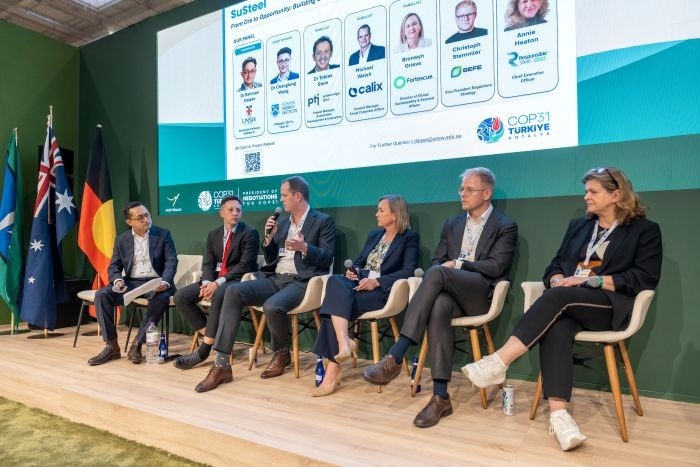 Image Credit: MCi Carbon
Under a staged program, JSW Steel will provide operating knowledge, representative slag samples and process information. JAKSON Green Ltd. will lead the project coordination, providing engineering, cost and logistics inputs, and implement an engineering, procurement and commissioning (EPC) perspective to potential deployment in India. MCi Carbon will run laboratory and pilot-scale testing in Newcastle to assess slag reactivity, carbonation performance and CO2 abatement potential.
The partners will then prepare a preliminary techno-economic assessment, drawing on JAKSON Green Ltd.’s local cost and engineering inputs, for a potential MCi Carbon plant integrated with JSW Steel’s operations.
MCi Carbon’s process accelerates the natural reaction between CO2 and mineral-rich materials, permanently binding CO2 in carbonates with potential uses in cement and concrete. It aims to cut emissions while creating value from steelmaking by-products.
The collaboration draws on JAKSON Green Ltd.’s experience in executing renewable energy and Power-to-X projects, including green hydrogen, and applies it to the decarbonization of steel, one of India’s hardest-to-abate industrial sectors.
Marcus Dawe, Founder and CEO of MCi Carbon, said:
“India is one of the fastest growing economies in the world, and it is complementing this growth by announcing innovative decarbonization policies and goals. India’s new emissions trading scheme for example, enables sustainable steel and cement solutions, and that is exactly what MCi Carbon’s technology delivers as the world decarbonizes. Our technology is perfectly suited to help India meet its goals, and we are proud to partner with JSW Steel and Jakson Green to bring Australian technology to that effort.”
Prabodha Acharya, Chief Sustainability Officer from JSW group said:
“This MoU supports our focus on practical pathways to reduce emissions and create value from steelmaking by-products. The staged evaluation will help us understand technical performance and commercial potential.”
Kannan Krishnan, Managing Director, JAKSON Green Ltd. said:
“Decarbonizing hard-to-abate sectors such as steel needs both proven technology and proven execution. JAKSON Green Ltd. brings deep engineering, procurement and commissioning experience to this collaboration, and we will help assess how this platform can be engineered and delivered at scale in India.”
How MCi Carbon’s Mineral Carbonation Technology Works
Mineral carbonation is a low-pressure, low-energy chemical reaction. Industrial CO2 is combined with a mineral-rich feedstock, in this case steel slag, and the two form a stable carbonate. The carbon is locked in permanently at the molecular level, with no leakage risk and no ongoing monitoring required. India’s steel sector generates millions of tons of steel slag each year, and this is expected to grow significantly as steelmaking capacity expands. MCi Carbon’s approach treats this slag as a feedstock rather than a waste stream, turning it, alongside industrial CO2, into carbon-embedded products with commercial value. This offers a way to cut emissions profitably, by putting CO2 to work in the materials the world already builds with.