QUT researchers have developed a modelling framework to quantify microplastic inputs from urban surfaces to ecologically sensitive water environments such as Moreton Bay.
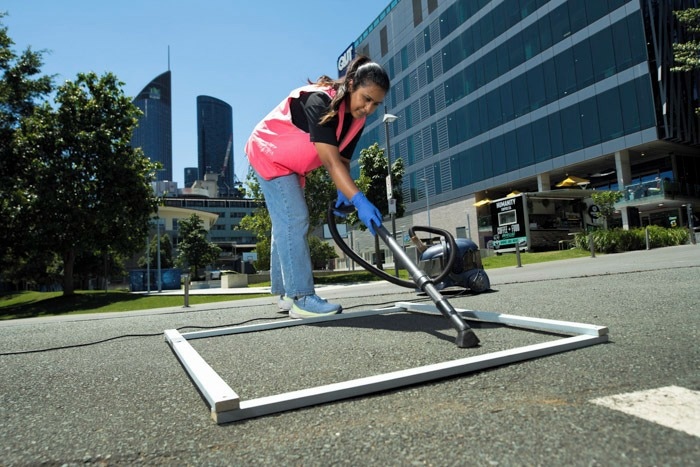 Image Credit: Queensland University of Technology (QUT)
Led by PhD candidate Mihiri Gunasekara from QUT's School of Civil and Environmental Engineering the research brings together four studies examining surface accumulation, pollution hotspots, land use influences and rainfall-driven microplastic transport in Brisbane catchments.
“Understanding what is already in our waterways is only part of the picture. We also need to understand where microplastics accumulate on land and the processes that deliver them to creeks,” Ms Gunasekara said.
“Urban roads and other impervious surfaces act as temporary storage areas for microplastics generated from traffic, tyre and road wear, plastic packaging litter or airborne dust during dry weather.
"Rain can then carry these particles through stormwater drains into creeks and rivers and where they may enter the food chain posing a risk to human and ecosystem health.
"If we are able to predict where and when microplastics accumulate, councils and water managers could intervene with street cleaning or stormwater measures.”
The researchers found that microplastic accumulation slowed after about 10 dry days, which suggested a useful window for tackling the buildup of microplastics before rain washes them into waterways.
"Although microplastics may continue to accumulate during longer dry periods, the slowing accumulation suggests that ongoing inputs may increasingly be balanced by processes that remove or redistribute particles,” Ms Gunasekara.
"As the dry period gets longer, gains and losses move towards a balance with new deposits, surface retention, and removal and redistribution through wind, or resuspension by pedestrians and vehicles.”
The researchers first collected dust from bitumen surfaces at QUT's Gardens Point Campus to investigate variations in dust build-up over different numbers of antecedent dry days to create a microplastic build-up curve.
"Then we sampled urban dust from two sites in each of four different land use sites - residential, commercial, industrial and natural - in the Bulimba Creek catchment,” Ms Gunasekara said.
"Microplastic concentration varied from 3 –7 particles per gram of dust in natural areas to the highest concentration of 24 particles per gram at a commercial site.
"The most common plastic types were polyethylene (PE) found in packaging, containers, pipes and electrical insulation, followed by polypropylene (PP) in packaging, automotive, medical and consumer goods industries.”
The researchers investigated how the particles reached waterways by collecting water samples from Bulimba, Kedron Brook, Enoggera, and Samford creeks using a custom-built
pumping and filtration system.
“We measured rainfall around Bulimba Creek to develop and assess a modelling framework that linked surface accumulation, rainfall run-off and downstream transport, then tested it independently in Kedron Brook and Enoggera Creek.
“We estimated that stormwater run-off washes 540 to 770 million microplastic particles per square kilometer from urban surfaces into the Bulimba Creek catchment each year.
“These estimates are subject to uncertainty in surface accumulation and rainfall-driven wash-off processes, and they represent the surface-runoff contribution rather than the total load from all sources.”