Large-scale technology trends and evolving everyday practices, from AI-driven systems and electrified homes to remote care and hybrid work, are likely to place increasing demands on the electricity system. This will likely be compounded by growing vulnerabilities from climate risks including extreme heat, bushfires, drought, riverine floods, and infrastructure disruption, new Monash University-led research has found.
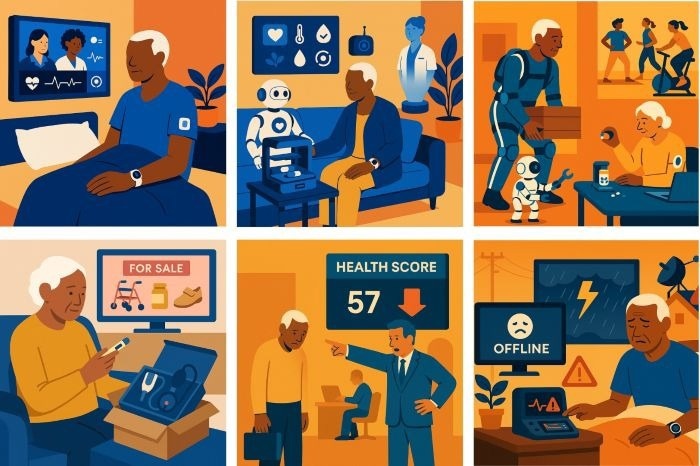 Vision 2 from the report showing possible future scenarios of aging at home. Image Credit: Monash University
The report, Scenarios for Future Living: Emerging technology innovation and development, drew on 93 reports, expert interviews and industry observations to identify trends that are expected to shape the future, including the rise of AI and automation, an ageing population and changing healthcare needs, and growing inequalities in access to housing and technology.
It also highlights shifts expected to affect everyday household practices, from increasing electrification of appliances and accelerated electric vehicle adoption to changes in how we cool or heat our homes, how we work, drive and charge.
Further, the researchers compared climate risks identified in the National Climate Risk Assessment and examined how a changing climate could influence and disrupt these emerging technologies and practices.
The study finds these risks are not evenly distributed, with older Australians, Aboriginal and Torres Strait Islander peoples, regional and remote communities, and lower-income households most exposed due to greater reliance on energy systems and unequal access to resilient technologies.
Industries including healthcare, aged care, agriculture, construction, logistics and energy are also likely to face increased disruption, with climate impacts reducing workforce capacity, straining infrastructure, disrupting supply chains and increasing demand on already pressured systems.
Social anthropologist and lead author Dr Kari Dahlgren, from Monash’s Faculty of Arts, said emerging technologies are being developed on assumptions that may not hold in a climate-constrained future.
“Much of today’s technology innovation doesn’t seriously consider the energy system implications of the technology,” Dr Dahlgren said.
“As climate risks intensify, technologies that depend on continuous power and connectivity may face greater challenges to how they function in everyday life.”
The report identifies several areas where this disconnect is most visible, including rising demand for cooling technologies in a warming climate, the need for more resilient digital and energy infrastructure, and the risks facing home-based healthcare and remote monitoring systems during power outages.
Monash Energy Institute Director (Research) and co-author Professor Yolande Strengers said the impacts of these vulnerabilities will be felt most acutely in the daily practices within our homes.
“These technologies are often framed as solutions to climate challenges, but they are deeply dependent on the very systems that are under increasing stress,” Professor Strengers said.
“We need to be considering these technological innovations and how they are likely to unfold in everyday life, to ensure the system continues to be resilient to these future changes.”
The researchers also developed six ‘visions’ of the future demonstrating how the identified trends of technology and innovation may play out in different parts of our everyday lives.
These include scenarios where older Australians rely on home-based healthcare supported by remote monitoring and assistive robots, homes become immersive digital environments powered by AI and extended reality, and households operate as highly automated, energy-optimized systems.
Other visions imagine modular, mobile homes that adapt to climate pressures, as well as a shift towards more energy-conscious living with fewer digital devices in response to environmental and social concerns. Across each scenario, increasing reliance on electricity and connectivity heightens exposure to climate-related disruptions.
Co-author Dr Fareed Kaviani from Monash’s Faculty of Information Technology said addressing these disruptions will require a shift in how technologies are designed and deployed.
“There is a growing need to design technologies that are not only efficient and advanced, but also resilient to disruption,” Dr Kaviani said.
“That includes building systems that can respond to increasingly volatile environments.”
Looking to the future, the researchers hope to focus on working directly with Australian households to better understand how these expected future trends are likely to be experienced in everyday life and to inform the development of more resilient, equitable and accessible technologies and energy systems.
The report was developed by a cross-disciplinary team of researchers from Monash University, including Dr Kari Dahlgren, Dr Fareed Kaviani and Professor Yolande Strengers, in collaboration with Dr Rex Martin and Dr Mike Roberts from the University of New South Wales.
The research forms part of the Scenarios for Future Living project under the RACE for 2030 co-operative research centre (CRC), bringing together Monash University, the University of New South Wales, the University of Technology Sydney and CSIRO, alongside industry partners including Ausgrid, CitiPower, Powercor, United Energy, Red Energy, the NSW Department of Climate Change, Energy, the Environment and Water, and the Victorian Department of Energy, Environment and Climate Action.
Funded by the RACE for 2030 CRC, the research provides evidence to guide industry and policymakers in building a fair and resilient energy system for the decade ahead.