The Commonwealth Environmental Water Holder (CEWH) has reached a significant milestone, delivering 20,000 gigaliters of Commonwealth environmental water to rivers, wetlands and floodplains across the Murray–Darling Basin since it began its work in 2009.
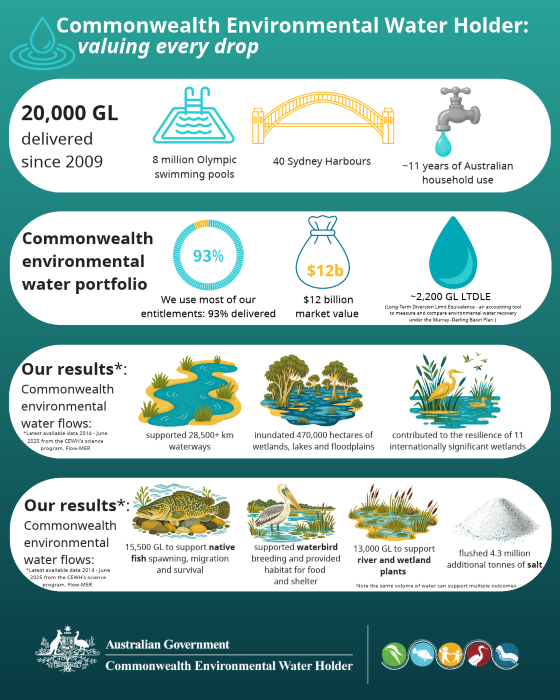 Image Credit: DCCEEW
The achievement is highlighted during National Water Week from 19 – 25 October and represents 17 years of careful planning, collaboration and innovation, helping to improve the health and resilience of some of Australia's most important waterways and ecosystems.
Commonwealth Environmental Water Holder Dr. Simon Banks said the milestone reflected the collective efforts of many people and organizations working towards a shared goal.
"Reaching 20,000 gigaliters of surface water delivered is an extraordinary achievement, but what I'm most proud of is what sits behind that number," Dr. Banks said.
"This success has been built on strong partnerships, good science and the dedication of countless people who care deeply about the health of our rivers, floodplains and wetlands."
"When environmental water was first delivered, we were focused on individual watering actions at individual sites. Today, we're planning and delivering a range of actions including complex, coordinated watering events, connecting rivers, wetlands and floodplains in ways that maximize environmental results."
He said achievements for the rivers, wetlands and floodplains of the Basin over the past 17 years have included:
- building the resilience of 11 internationally significant Ramsar wetlands
- supporting the survival, spawning and migration of native fish to help populations bounce back
- supporting large-scale waterbird breeding in wet years, such as at Macquarie Marshes and the lower Murrumbidgee floodplain, and providing habitat for food and shelter for woodland and waterbirds in dry years
- restoring river connectivity in dry times – for example, environmental water was 90 percent of flows in the Barwon-Darling in 2017-18
- supporting recovery of nationally threatened species like the southern bell frog, Murray hardyhead and Australasian bitterns
- flushing 4.3 million tons of salt from the Basin and mitigating poor water quality
- supporting river connectivity to the Coorong.
"The benefits of environmental water extend well beyond rivers, wetlands and floodplains. Healthier waterways support regional communities, recreation and tourism, improve water quality, and help sustain industries that rely on resilient river systems," Dr. Banks said.
"Environmental watering has also created opportunities for stronger partnerships with First Nations peoples, supporting cultural connections to Country, the sharing of Traditional Knowledge, and the protection of culturally significant sites and species."
"By working closely with Basin communities, water managers, landholders and First Nations, environmental water has delivered outcomes that support both healthy ecosystems and thriving communities."
Dr. Banks said every gigaliter delivered represented considered planning, collaboration and a commitment to learning and improving.
"Commonwealth environmental water is delivering real results for the Murray–Darling Basin, helping achieve Basin Plan outcomes and supporting healthier rivers, wetlands and floodplains for communities, wildlife and future generations," he said.
"The knowledge and expertise developed over the years has transformed environmental watering into one of the most sophisticated river management programs in the world."
"The milestone highlights the evolution of environmental watering from a relatively new concept into a mature, evidence-based approach that supports native fish, waterbirds, vegetation, connectivity and ecosystem resilience."
Dr. Banks said the achievement belonged to everyone who had contributed to the journey.
"This milestone is the result of thousands of individual efforts over many years. It belongs to delivery partners, scientists, Traditional Owners, community members, stakeholders and our staff, who have worked together to value every drop of water we manage," he said.
"While we're proud of reaching 20,000 gigaliters, our focus remains firmly on the future. Healthy rivers and wetlands do more than support plants and wildlife. They help sustain communities, cultural connections, regional industries and places people value."
"Together with our partners, we'll continue working to achieve the best outcomes possible outcomes for people, communities and the environment."
As environmental challenges continue to evolve, the CEWH remains committed to using environmental water strategically and collaboratively to support healthy, connected and resilient riverine environments.