On Vanuatu’s outer islands, a solar-powered freezer can change a family’s livelihood. Fish and other produce can be stored rather than sold immediately, giving households more control over when they sell and earn income.
 A council office in Vanuatu. Image Credit: Shanil Samarakoon
But when a component fails, a lack of spare parts – or someone who knows how to fit them – can leave that investment sitting idle.
UNSW Sydney Scientia Associate Professor Paul Munro says around half the solar-powered freezers he and his team examined in Vanuatu were no longer working.
“A household buys a solar freezer and it’s game changing,” he says.
“But as soon as it breaks, it’s really devastating because all of a sudden you can no longer stock your produce.”
Vanuatu’s scattered islands make off-grid solar home systems essential for basic energy services such as lighting, phone charging and powering household appliances.
A/Prof. Munro and his UNSW colleague Dr Shanil Samarakoon work with local partners to co-design and deliver in-community training for solar repair. They work with likeminded partners in the sector to influence how solar products are designed, maintained – and how repair is financed.
“There’s been this massive transition from almost no solar 15 years ago to it being everywhere,” A/Prof. Munro says of the trend across the Pacific.
“But one thing we’re realizing is there is this issue of a lot of products breaking within two, three years.”
A Working Panel, a Broken System
The researchers have spent years studying how solar technologies reach people living off-grid.
In Vanuatu, a household may have several separate systems serving different purposes.
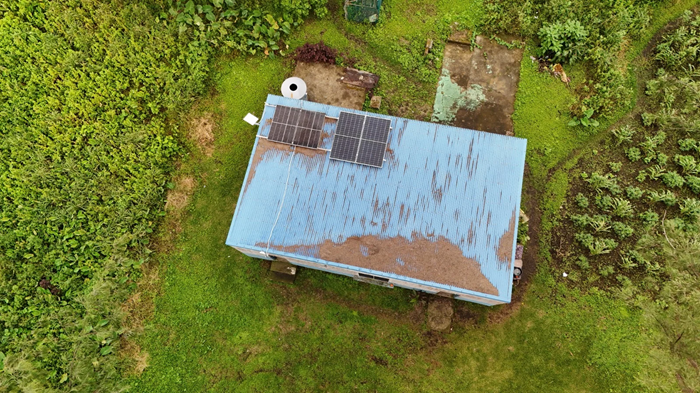
The team documented one home with 13 panels on its roof, each connected to a different system.
“It’s often a panel to one light, a panel to a stereo, a panel for charging phones,” he says.
Many of these smaller products have a panel, battery and a few lights. They come with warranties of about two years.
Often, the panel outlasts the other components.
“The main thing that’s breaking is not the panel. The panel tends to be pretty good,” A/Prof. Munro says.
He says battery failure is the most common problem the team encounters in Africa and the Pacific. Damaged wiring, storms, poor installation and cheaper components can also leave equipment unusable.
“The big thing is, most of them are repairable because it’s a component that breaks. It’s just a battery cell needs replacing,” he says.
On a remote island, however, finding the skills, tools and parts to make that repair can be difficult. Some parts may need to come from overseas.
Bringing Repair Closer to Home
The team’s Fixim Sola project is based in Vanuatu. The collaboration with the country’s Department of Energy, the Vanuatu Institute of Technology and local communities to bring resources closer to households.
“We're creating the conditions for solar repair to thrive in Vanuatu. This links expertise, parts, and tools with local repair hubs. This way, systems stay in use and communities stay connected,” says Dr Samarakoon.
Supported by the Australian Department of Foreign Affairs and Trade, the project connects training at national, provincial and school levels. Dr Joyce Wu, a UNSW gender and development researcher, also contributes to the work in Vanuatu.
Solar importers have trained institute educators to repair their latest products. Those trainers then deliver intensive vocational courses for participants who are recruited through local councils. The participants travel from different islands to attend workshops.
“We gave each graduate their own toolkit in the end,” A/Prof. Munro says.
“And then we worked with them to get spare parts and other things as well through repair hubs.”
Across the program, 141 people from eight islands have been trained. Graduates have established repair businesses and community hubs – improving access to repair services for more than 93,000 people.
“There is strong enthusiasm for local repair, particularly among essential government services on these islands that would benefit from local capacity to maintain and repair critical systems,” Dr Samarakoon says.
The graduates have completed an estimated 200 repairs so far.
The team also piloted week-long courses at two senior secondary schools, teaching basic maintenance and safe repairs on small solar products.
The idea is to build a pathway from basic solar knowledge at school to vocational courses and advanced technical qualifications.
“They absolutely loved it,” says A/Prof. Munro of the students.
With senior secondary schools located on only nine islands, boarding students can take their skills home to communities across the archipelago.
A US$200,000 Macquarie Community Resilience Prize will support further work in Vanuatu over the next two years.
The researchers are also exploring opportunities in Timor-Leste and elsewhere in the Pacific.
Changing the Industry
Local repair skills can only go so far. Products can be difficult to open and inspect – and replacement parts might not be available when needed.
Through Australian Research Council-supported work in Africa, A/Prof. Munro, Dr Samarakoon and their collaborators are investigating repair practices in Malawi and Zambia.
The Solar Repair Lab, established with the Global Off-Grid Solar Association, the Collaborative Labeling and Appliance Standards Program (CLASP), SolarAid and the Energy Saving Trust, provides a platform to connect that research with industry practice.
The team’s recently launched 2026 State of Repair report draws on surveys and interviews with manufacturers, distributors and users across the off-grid solar sector.
The researchers are encouraging manufacturers to design products that are easier to repair, to use standard spare parts and to offer longer warranties.
Recently, a major manufacturer and distributor in the sector extended their warranty from two to five years.
“We work with investors in the sector to get them to demand more repairability,” he says.
Another research partner is developing a repairability index that could help investors assess products and make repairability a condition of funding.
The goal is to link household issues with choices made before the equipment arrives.
“We’re trying to influence things upstream as well as downstream,” A/Prof. Munro says.
“No single organization can solve solar waste.
“UNSW’s role is to bring the pieces together, so that solar set ups continue to provide affordable energy to remote areas sustainably into the future.”
The solar share of household lighting across the Pacific, 2005–2025. Video Credit: Shanil Samarakoon and Paul Munro
Engagement Australia awards: Excellence in International Engagement winner - Paul Munro
The team are building a global solar repair ecosystem. Video Credit: Aleks Wynne