Increasing wind in the global energy mix together with solar and batteries can cut the cost of electricity by nearly a fifth, according to a new analysis by energy think tank Ember, produced in partnership with the Global Wind Energy Council (GWEC).
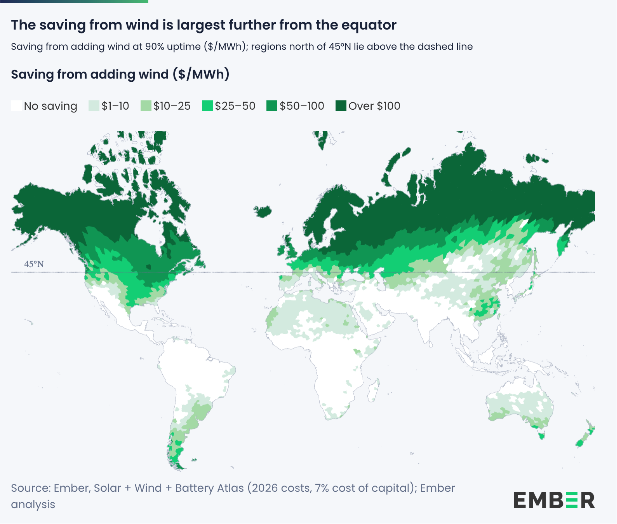 Image Credit: Ember, Solar + Wind + Battery Atlas (2026 costs, 7% cost of capital); Ember
As solar and wind electricity generation can vary at different times of the day and across seasons, using both technologies can help fill the gaps left by the other. This reduces the amount of battery storage needed and makes reliable renewable electricity cheaper.
Analysis published by Ember in collaboration with GWEC now quantifies the potential savings from this complementarity, and is available through Ember’s Wind + Solar + Battery Atlas, an open-source interactive tool that lets users look up the cost of reliable electricity in their own region.
The analysis finds that adding wind to solar and batteries cuts the median cost of meeting 90% of electricity demand from $105 to $86/MWh, a savings of around $20/MWh. The median cost of firm solar and wind power covering all demand is just $89/MWh, with batteries and a little backup.
With wind, regions accounting for three-quarters of global electricity demand can meet 90% of their demand for under $100/MWh. Without wind, only half can. In Europe, the battery needed to meet 90% demand shrinks from 20 hours of load to 12 hours with wind, and in China, from 18 hours to 12 hours.
“We already know that solar and wind are cheap. The much more interesting question is how cheaply we can make them reliable. And the answer is increasingly clear: by combining solar, wind and batteries, we can deliver reliable power at remarkably low costs almost everywhere in the world. That's a pretty fundamental shift in the economics of energy,” said Daan Walter, Principal at Ember.
“Generating clean, affordable and reliable electricity day and night, wind power is an essential part of any clean energy mix and the ideal complement to other renewable energy technologies. Ember’s new Wind + Solar + Battery Atlas now quantifies this complementarity in financial terms, showing the huge savings to consumers that can be gained by combining wind power with solar and batteries,” said Ben Backwell, CEO of GWEC.
Wind makes renewable electricity more reliable by reducing risk of prolonged periods when both sources produce less power. A week of low solar and wind output occurs at the same time only about once every four years on average globally, weighted by electricity demand. By comparison, a week of low solar output alone occurs roughly four times a year. Combining the two sources therefore makes prolonged gaps in renewable electricity supply much less frequent.
The findings also challenge the case for building new coal and gas power plants. The world has 845 GW of coal and gas capacity in planning. At the 90% demand benchmark, adding wind increases the share of this planned capacity for which solar, wind and batteries offer a cheaper alternative, at under $100/MWh, from 71% to 90%. In China alone, adding wind brings another 91 GW of planned coal and gas capacity into the range where renewables are cheaper.
When backup is included to cover the remaining hours, 706 GW of planned coal and gas capacity is in regions where firm renewable electricity costs under $100/MWh. Without wind, this falls to 520 GW. These comparisons show that renewable alternatives are already competitive with much of the planned pipeline, even when some backup is needed.