Watercycle Technologies has secured £1 million in grant funding provided by the UK Government for CAMCYCLE, a £2 million project to demonstrate a new approach to recycling lithium-ion batteries and producing new battery materials in the UK.
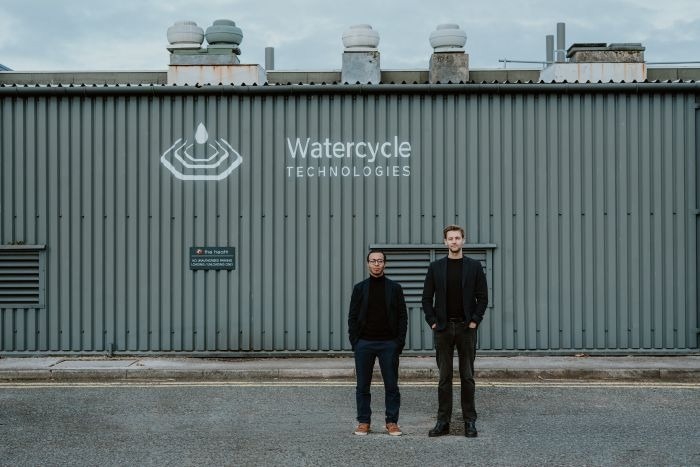 Dr. Seb Leaper and Dr. Ahmed Abdelkarim at Watercycle. Image Credit: Watercycle Technologies Ltd
The funding has been awarded through the DRIVE35 Innovation Fund: Demonstrate 2 competition, as part of the UK Government’s £4 billion DRIVE35 program, delivered by the Department for Business, Innovation, Science and Trade in partnership with the Advanced Propulsion Centre UK (APC) and Innovate UK.
Led by Watercycle Technologies and supported by CPI, the 12 month project delivers a shorter and more efficient route for turning end-of-life batteries into recycled cathode active material (CAM), a critical component of EV batteries.
Currently, conventional battery recycling involves breaking waste batteries down into their individual minerals before those materials are processed through several stages to produce new battery material.
CAMCYCLE cuts out at least three of these stages by integrating battery recycling and CAM production into a single, streamlined process. It will also remediate wastewater generated during recycling, recovering valuable minerals and feeding them back into the process rather than allowing them to go to waste.
The project addresses a significant gap in the UK battery supply chain. The UK currently has no domestic CAM production and end-of-life battery material is exported overseas for processing, taking valuable critical minerals and economic value with it.
By creating a viable route to produce CAM from recycled batteries in the UK, CAMCYCLE could help retain more lithium and other critical minerals domestically, reduce reliance on international supply chains and provide more cost-competitive battery materials for the UK automotive industry.
Dr. Ahmed Abdelkarim, CSO & Co-founder of Watercycle Technologies, said: “This project is about strengthening Britain’s industrial resilience. The critical minerals inside end-of-life batteries are strategic assets for the UK yet today we export that value overseas and then buy it back at a premium. CAMCYCLE shows that the UK doesn’t have to accept this dependency and that we can directly convert black mass to domestic CAM production.”
Frank Millar, CEO, CPI, said: "CAMCYCLE demonstrates how UK innovation can help build a more resilient and sustainable battery supply chain while retaining the value of critical materials here in the UK. We're proud to support Watercycle Technologies in accelerating this promising technology towards commercial deployment. Partnerships like this, backed by government investment, are essential to strengthening UK manufacturing capability, driving economic growth and advancing the transition to a more circular economy."
CAMCYCLE builds on Watercycle’s ReCAM project which it secured Government funding for in May 2026, in a consortium with UKBIC, Recyclus Group and Polaron, to start development of the short-loop conversion process.
This funding will enable Watercycle to accelerate upgrades to its pilot facility while the company continues to develop its larger-scale recycling system.
Ian Constance, Chief Executive at the Advanced Propulsion Centre UK, said: “This investment is about far more than individual projects. It is about strengthening the UK's capability to design, develop and build the technologies that will define the vehicles of the future. By bringing together industry, government and academia, DRIVE35 is helping create the conditions for long-term growth, increasing investor confidence and reinforcing the UK's position as one of the world's leading destinations for automotive innovation.”