PFASs are persistent synthetic chemicals widely used in industrial and consumer products because of their water- and oil-resistant properties. Once released into soil, they can enter vegetables and crops, creating a direct dietary exposure pathway. Microplastics (MPs), defined as plastic particles smaller than 5 millimeters, are also widespread in farmland through plastic mulching, wastewater irrigation, sewage sludge application, atmospheric deposition, and tire wear. Previous studies have shown that MPs can adsorb pollutants or alter soil and plant processes, but how different MP types affect polyfluorinated alkyl substances (PFASs) uptake by edible vegetables has remained unclear. Due to these challenges, there is a need to conduct in-depth research on how microplastic types regulate PFAS bioaccumulation in crop systems.
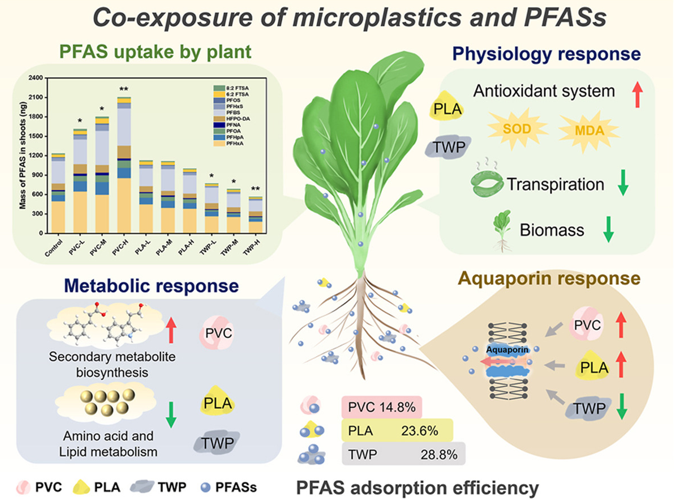 Microplastic type shapes PFAS uptake and plant responses. Schematic overview of how different microplastic types affect per- and polyfluorinated alkyl substances (PFASs) uptake and physiological responses in pak choi. Polyvinyl chloride (PVC) increased PFAS accumulation, likely through enhanced aquaporin-related transport, while tire wear particles (TWP) reduced PFAS uptake through stronger adsorption, inhibited transpiration, and growth suppression. Polylactic acid (PLA) caused metabolic and physiological stress but had limited overall effect on PFAS accumulation. The figure highlights that microplastic–PFAS co-exposure in soil depends strongly on polymer type, adsorption behavior, plant water transport, and metabolic regulation. Image Credit: Eco-Environment & Health
Researchers from the State Key Laboratory of Water Pollution Control and Green Resource Recycling, School of the Environment, Nanjing University, reported (DOI: 10.1016/j.eehl.2026.100216) the findings in Eco-Environment & Health on January 19, 2026. The original research article examined how polyvinyl chloride (PVC), polylactic acid (PLA), and tire wear particles (TWP) influence the uptake of 10 PFASs by pak choi (Brassica chinensis L.).
The study revealed sharply different effects among the three MP types. PVC significantly increased total PFAS accumulation in pak choi shoots by 1.31- to 1.70-fold across all doses, including 0.01%, a level comparable to the upper range reported in farmland soils. The researchers linked this increase not to stronger adsorption, but to plant physiological regulation. PVC exposure upregulated aquaporin-related genes, including PIP1-1, TIP1-1, and TIP1-2 in shoots and NIP5-1 in roots, suggesting enhanced water transport that may facilitate PFAS movement from soil into edible tissues. In contrast, TWP reduced PFAS accumulation in shoots by 37.4%–54.1%, partly because it showed the strongest PFAS adsorption capacity and partly because it suppressed plant growth and transpiration. At the highest dose, TWP reduced transpiration rate to 73% of the control and triggered oxidative stress, as indicated by changes in malondialdehyde (MDA), superoxide dismutase (SOD), and peroxidase (POD). PLA inhibited growth and metabolism, but its opposing effects on toxicity, sorption, and aquaporin expression largely offset each other, leaving PFAS uptake mostly unchanged.
The authors said the findings show why microplastic pollution cannot be treated as a single, uniform risk. They said PVC may increase the transfer of PFASs into edible vegetables by changing plant water-transport pathways, while TWP may reduce PFAS uptake but introduce a separate ecological concern by damaging plant growth. The authors said the key message is that the material identity of microplastics matters. They added that risk assessment should move beyond total microplastic abundance and consider polymer type, particle behavior, plant response, and co-existing contaminants when evaluating agricultural soil safety.
The study has important implications for food safety, soil management, and emerging contaminant regulation. Because PVC increased PFAS accumulation even at environmentally relevant levels, farmland contaminated by both plastic residues and PFASs may require closer monitoring. TWP deserves attention in roadside and industrial soils, where tire-derived particles may be abundant and phytotoxicity could affect crop performance. The findings also suggest that biodegradable plastics such as PLA should not be assumed risk-free without evaluating their ecological effects. Future work should test more crop species, realistic field conditions, and mixed plastic pollution scenarios to support stronger strategies for preventing PFASs and MPs from entering the food chain.