Adelaide University researchers have developed a new approach to soil testing that could help Australian farmers avoid crop damage caused by leftover herbicides.
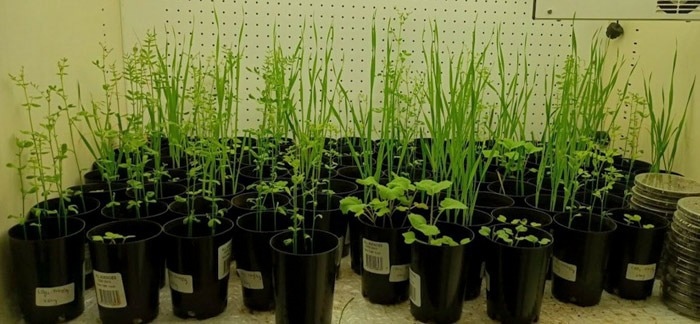 Phytotoxicity of Imazamox residues on sensitive crop varieties. Image Credit: Vijay Kumar Aralappanavar.
Herbicides are essential for controlling weeds, but chemicals remaining in the soil after application can damage crops planted in subsequent seasons, particularly during dry conditions.
The problem, known as herbicide carryover, can stunt crop growth, reduce yields and cause financial losses for growers.
Now, research led by the Future Industries Institute at Adelaide University and supported by the South Australian Grain Industry Trust and the Grains Research and Development Corporation, has shown that a testing technique called Diffusive Gradients in Thin-Films (DGT) can more accurately predict the risk of herbicide damage across different soil types than conventional testing methods.
Lead researcher Dr. Vijay Aralappanavar said the findings could help farmers make more informed crop rotation decisions.
“Traditional soil tests measure how much herbicide remains in the soil, but they don't necessarily tell farmers how much of that herbicide can actually be taken up by plants,” Dr. Aralappanavar said.
“This is important because the presence of herbicide residues doesn't automatically mean a crop will be damaged.”
“Our research shows that DGT testing provides a more consistent indication of the herbicide available to plants and its potential to affect crop growth.”
Published in the journal Environmental Science & Technology, the study examined the herbicide Imazamox, commonly used to control weeds in Australian grain and oilseed crops.
Researchers tested six contrasting soil types collected from South Australian cropping regions, measuring herbicide residues and their effects on wheat root growth.
They found that soil characteristics, particularly acidity and clay content, strongly influenced how long herbicides remained in the soil and their potential to damage crops.
Unlike conventional methods, DGT measures the fraction of herbicide that is potentially available for plant uptake, providing a clearer picture of the actual risk.
Co-author Professor Enzo Lombi said the research addresses an important challenge facing Australian grain growers.
“Farmers need reliable information about whether herbicide residues in their soil could affect their next crop,” Professor Lombi said.
“Current testing methods can identify residues, but interpreting what those results mean for crop health is difficult to apply when different soils behave very differently.”
“This technique has the potential to take much of that uncertainty out of crop rotation decisions, helping growers minimize losses while making better use of their land.”
The researchers are now working on a project to further develop the technology.
The project will investigate commercially used herbicide mixtures, how residues are distributed through soil and the sensitivity of important crop varieties.
Dr. Aralappanavar said the ultimate goal is to provide growers with practical information to guide planting decisions.
“With further development, this approach could help farmers identify which crops can be safely grown in soils containing herbicide residues, reducing the risk of crop damage and unnecessary financial losses.”